Branded Content by Cosmic Press
Once you have decided to walk the Tour du Mont Blanc, one question comes up before almost any other: which direction should you go? It sounds trivial, but it genuinely shapes the experience. Here is the answer, along with the other questions every first-timer asks.
Clockwise or Anticlockwise?
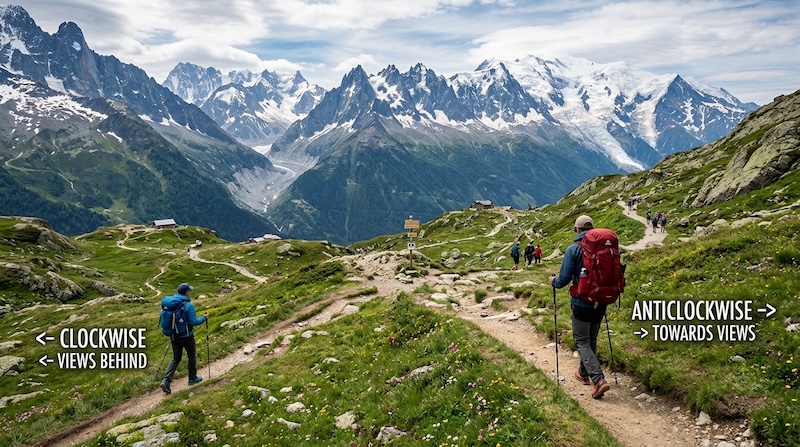
The vast majority of walkers tackle the Tour du Mont Blanc anticlockwise, starting in Les Houches near Chamonix and heading first towards Les Contamines. There is a good reason for this. Walking anticlockwise means the classic views of the Mont Blanc massif gradually open up in front of you as you progress, building towards the spectacular finale of the balcony trails high above the Chamonix valley. It is the direction the route is traditionally described in, and the one most guidebooks and signage assume.
Walking clockwise is entirely possible and has its own advantages. You will meet the majority of walkers coming the other way, which some people enjoy for the constant stream of friendly faces, and you will have the great peaks behind you for much of the walk, then turning to face them. The main practical consideration is that if you walk clockwise, you are going against the flow, which can mean busier trails at the pinch points and huts, and you lose the sense of the views building towards a climax. For most first-timers, anticlockwise is the recommended choice, but neither direction is wrong.
How Long Does It Take?
The classic Tour du Mont Blanc takes ten to eleven days to walk in full. Fit and experienced walkers sometimes complete it in fewer, combining stages, while others take longer, adding rest days or splitting the harder stages. There are also shorter options: you can walk a highlights section over a long weekend, or tackle roughly half the circuit in five or six days. How long you need depends on your fitness, your pace, and how much you want to linger along the way.
How Fit Do I Need to Be?
The Tour du Mont Blanc is challenging but achievable for most reasonably fit walkers. The daily distances are moderate, typically five to eight hours of walking, but the ascents and descents are substantial, often over 1,000 metres of climbing in a day. You do not need any technical skills, but you do need to be comfortable walking uphill and downhill for hours on consecutive days. The single best thing you can do to prepare is to train on hills beforehand, ideally carrying the pack you intend to use, so that your legs are ready for the sustained climbs and descents.
Do I Have to Carry Everything?
Not at all. While some walkers carry full packs and stay in the more basic refuges, many now take advantage of baggage transfer services, which move your main luggage ahead to your next stop each day, leaving you to walk with only a light daypack. This makes a huge difference to the daily experience, particularly on the big climbs, and it opens the route up to walkers who might otherwise find carrying a full pack too demanding. It is one of the simplest ways to make the walk more enjoyable.
When Should I Go?
The Tour du Mont Blanc season runs from mid-June to mid-September, when the high passes are clear of snow and the refuges are open. July and August are the warmest and busiest months; late June and early September offer thinner crowds but a slightly higher chance of unsettled weather or lingering snow on the highest passes. Whenever you go, mountain weather can change quickly, so you must be prepared for everything from hot sun to cold rain.
Should I Book Ahead?
Yes, and this is the single most important piece of practical advice. The refuges along the Tour du Mont Blanc fill up months in advance during peak season, and turning up without a booking is not an option in July and August. Coordinating this chain of bookings across three countries, in three languages, and matching the daily distances to your ability is the most demanding part of planning the walk.
This is why many walkers choose a guided or self-guided mont blanc hiking tour, which takes care of all the refuge bookings, baggage transfers, and route planning, removing the one genuine headache of the TMB and leaving you free to focus on the walking. Whether you go clockwise or anticlockwise, carrying everything or travelling light, the Tour du Mont Blanc remains one of the great walking experiences in the world, and getting these practical questions right is the key to enjoying every step of it.
Branded content furnished by our promotional partners. The Daily Sundial editorial staff is not involved in its production. Content does not reflect the views or opinions of the editorial staff.