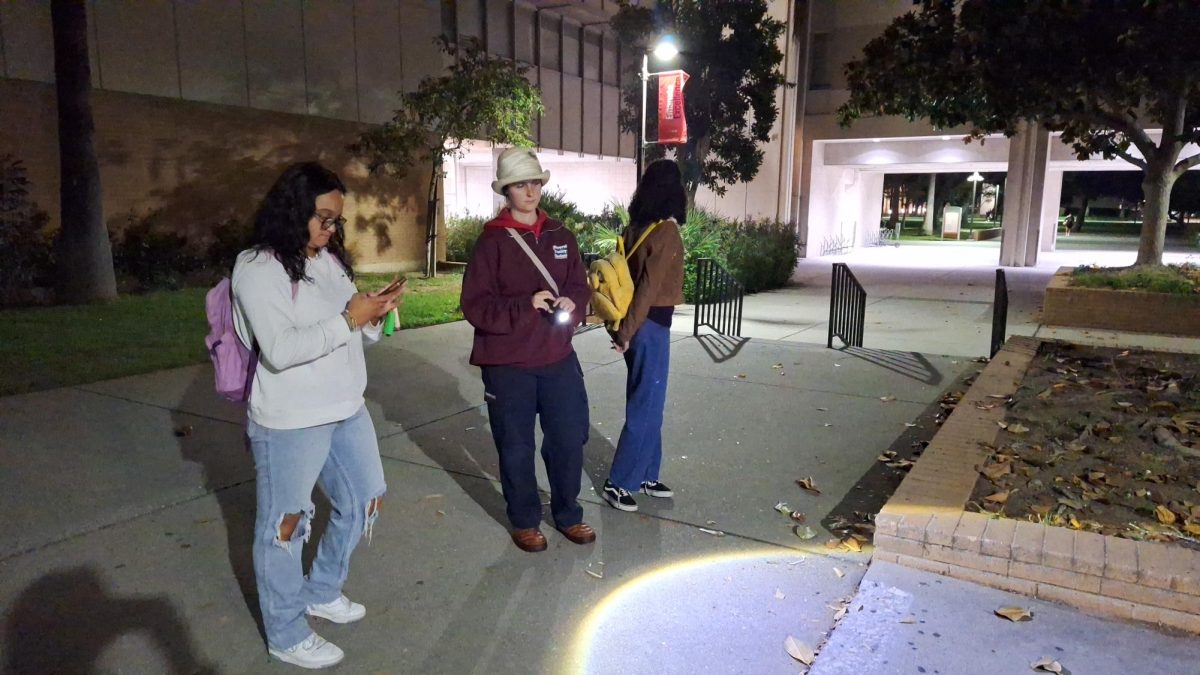
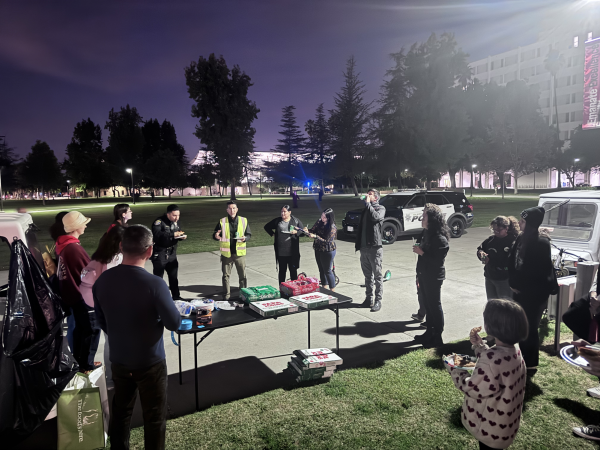
As the sun set over CSUN on Nov. 5, a group of students, staff and CSUN Environmental Health and Safety (EHS) officials gathered in front of the University Library on Matador Walk. Armed with flashlights and clipboards, they set out across campus for the annual Night Safety Walk – a hands-on effort to spot dimly lit pathways, overgrown landscaping and other nighttime safety concerns.
The event, which has been an annual occurrence since the 1994 Northridge earthquake, takes place around the beginning of November during the time change when clocks are set back an hour. According to EHS Director Daniel Castellon, this is the perfect opportunity to reach out to the Physical Plant Management (PPM) to handle any repairs, like issues with the automatic timers for lights on campus.
“We’re looking for hazards and to keep the campus safe,” Castellon said. “That there’s enough lighting, or maybe the trees need to be trimmed down because they are blocking the lighting on that side. Just a safer campus for our students.”
EHS planned the walk in different sections of campus to ensure any issues reported could be located easily by mapping out exactly which building it was next to.
While EHS does not cover public safety concerns, CSUN Police Services (DPS) were invited to patrol the section covering the Orange Grove. Castellon urged students to follow the DPS’s safety advice for students.
“You can contact them for escort services. So if you ever need some help walking back to your car, if you ever feel like someone is following you or something is going on, you have the blue lights throughout the campus,” he said. “Walk with a friend. This one’s gonna be hard; Don’t be distracted. Don’t be on your phone because someone can sneak up on you, and then what?”
(Marcus Rogers)
Kayce Smith, environmental compliance specialist for EHS, has led three night safety walks as a faculty member and attended one as a student in 2013.
Smith’s work mostly deals with accident injury investigation and safety related to labs, both research and instructional, making sure that they are achieving compliance with safety standards and environmental regulations on campus.
He shared that the department has received a lot more scooter accident reports this semester than in previous ones, including complaints about scooters driving on sidewalks alongside pedestrians, making it a safety concern.
When an injury is reported and a call to emergency services is made, the fire department or the DPS sends a report to EHS.
Some of the continuing problems documented during the event were concrete being lifted by tree roots, making uneven parts in the sidewalk, and single directional lighting, which can make it harder for these cracks to be visible at night.
Another advantage of having the walk at night, according to Smith, is giving them a different perspective on these issues on campus.
“I think it’s important because we don’t have as big a population at night as we do during the day and people who are here at night are just trying to get on campus and off campus and get back home or wherever they’re going,” Smith said. “So we don’t get a lot of the reports we would get at daytime, and things are just different at nighttime. You don’t know if lights are off during the day. How can you fix a problem if you don’t know it exists?”
To both EHS members, encouraging students to come out to the walk themselves to provide feedback is a main goal. In order to help the faculty be more aware of any concerns, they need the help of the students.
“Without their feedback, there’s not gonna be any change,” Castellon said. “This is for them.”
Amelia Escalante, a senior majoring in psychology, joined the event alongside friends Cherish Williams and Bella Pulliam, wanting to contribute however they could in being the eyes and voice for the students who walk on campus late at night. All three are part of the Associated Students (AS) Diversity, Equity and Inclusion (DEI) committee.
Escalante, who lives in the dorms, believes one of the pathways near the baseball field could use more lights and more emergency blue light phones. Currently, there is only one visible along the entire path.
“Half of the pathway is dark, so there is a point of not complete darkness, but not bright like it is around us right now,” she said. “Then housing itself does have dark parts in between buildings and walking in general.”
This semester, she started using a scooter to get from the dorms to her classes, preferring to travel faster that way. While she has no evening classes, Escalante carries pepper spray with her at all times, whether traveling by scooter or by foot, making sure she is always aware of her surroundings.
“I have never gotten to use it, thank god, but yeah, I do take this everywhere,” Escalante said. “I don’t want to say necessary, but precautionary for, like, it could happen.”
For more information regarding safety on campus, students can go to the EHS or DPS website. In the case of an emergency, students should dial 911.