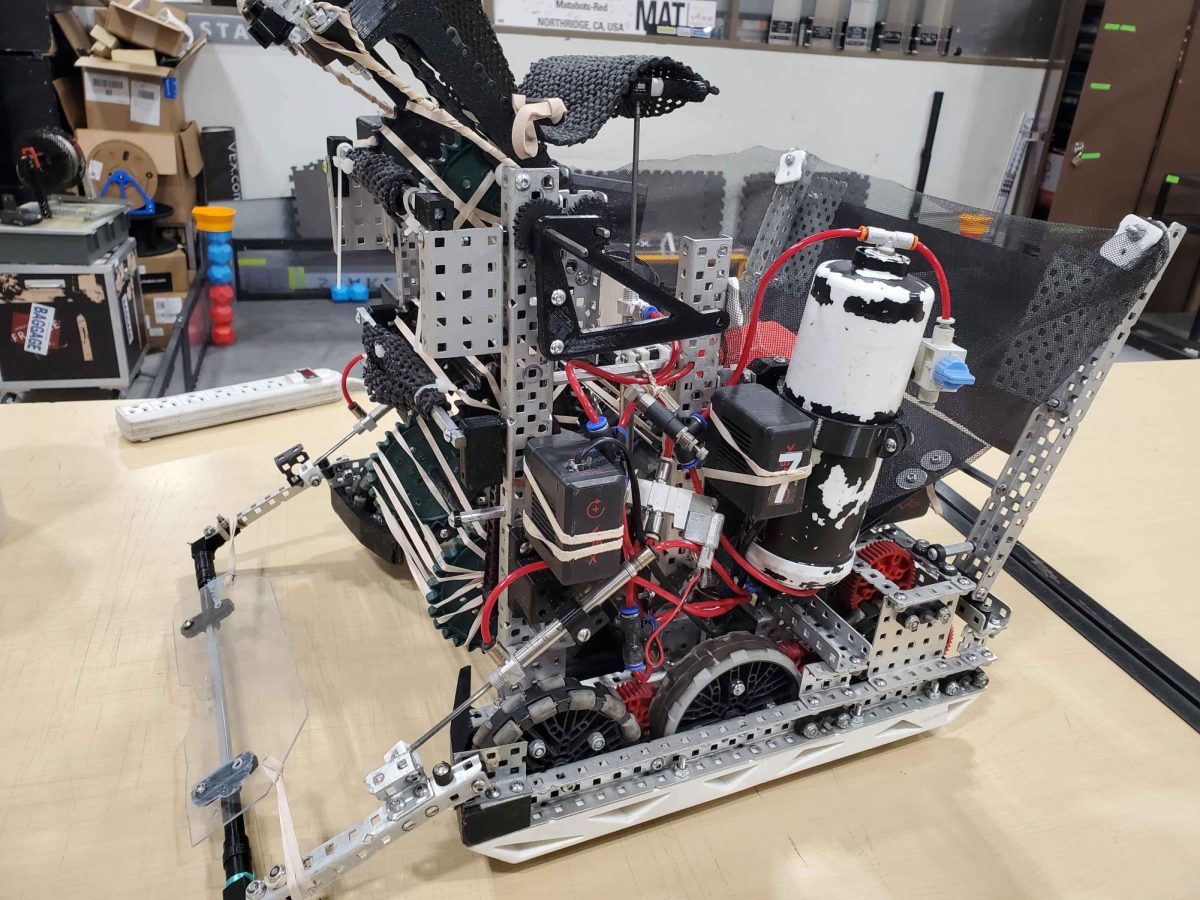
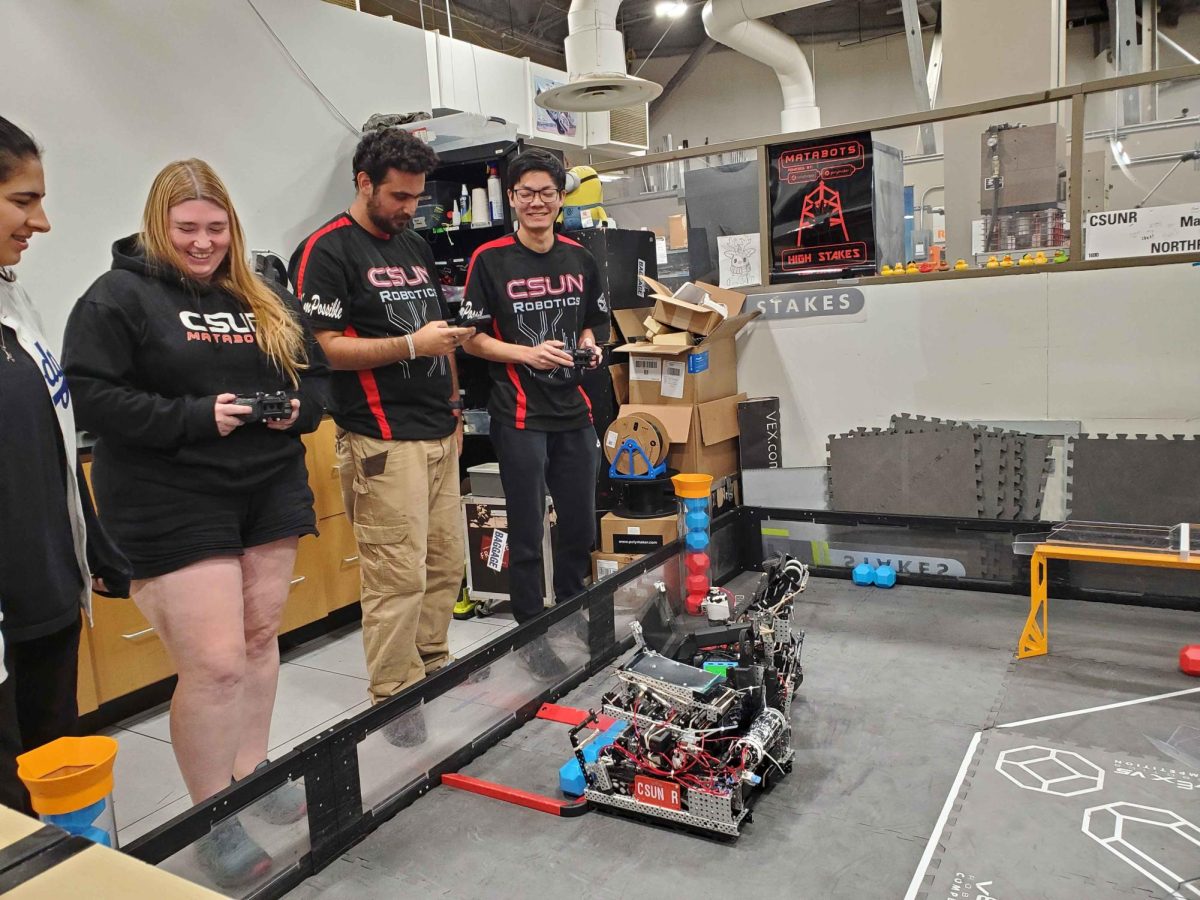
Drilling and whirling away at Jacaranda Hall in room 1128, CSUN’s VEX Robotics club is preparing for their next tournament. Club members are working together to build the best robot for the upcoming global VEX competition, where a new game is created each year.
VEX is a global robotics program open to students from pre-K up to university level. Each year, VEX holds a competition in which students from around the world compete. This upcoming competition will take place in America’s Center Convention Complex in St. Louis, Missouri, from April 21 to April 30, 2026.
Each VEX competition has a game in which students from around the world build robots to compete against one another. This year, the game is called Pushback.
In Pushback, there are four goals located around the field. Teams will earn points from scoring in the controlling zones within the goals and the goal areas themselves. The team will also gain points for being able to successfully park their robots at the end of the match in the parking zones.
“I love going to the competitions,” said Justin Ishikawa, treasurer for the club. “It’s a great atmosphere because we’re able to interact with these other schools. We get to exchange ideas, talk about how our studies are going and we make a lot of friends, not only from CSUN but also abroad.”
As a mechanical engineering major, Ishikawa finds that being a part of the Matabots gives him a very hands-on experience. The club allows him to apply his experience and experiment firsthand.
“I found that this would offer somewhere for even beginners to begin, like expressing creativity through engineering,” Ishikawa said.
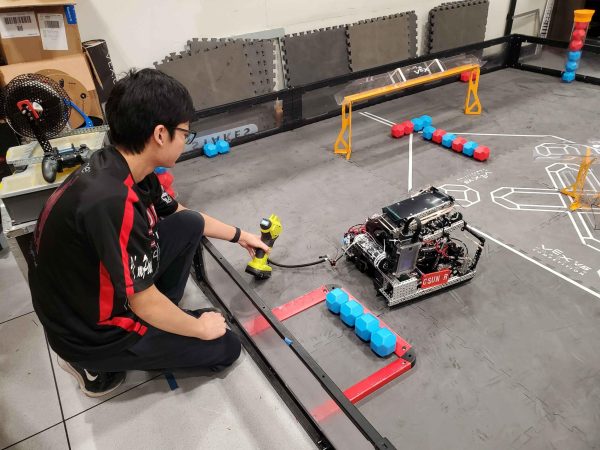
The club is open to all majors, and members offer students interested a testing trial to see how they like it. Everyone in the club said they are open to teaching and helping new members learn more about robotics.
“It’s really open to anybody as long as you have an interest or a passion,” said Vice President Sophie Evans, a senior also majoring in mechanical engineering. “It’s, like, not only engineers. We will accept psychology majors, biology majors, like theater kids – whoever really wants to join. If you love robotics, if you want to test it out, we’re here for you guys.”
Evans was first introduced to robotics in high school. She was a part of First Robotics Competition (FRC), a program run by a sister company to VEX. Evans went into college wanting to join the robotics club because of her past experience.
In a similar fashion, Mahyar Hashemi-Alavi, a senior mechanical engineering major and the president of the club, also sought out the club due to his own experience in high school doing robotics and VEX. Through Matabots, he learned skills he never considered before, such as programming, which he found developed his own pursuits and career.
“Being able to get that experience and understand what it is I want to do and what it is I want to develop was really kind of where it got me wanting to do more and wanting to develop that knowledge and that experience,” Hashemi-Alavi said.
Hashemi-Alavi said as president he aims to help other students develop their own understanding of engineering and find which aspects they enjoy most that can translate into future career opportunities.
The Matabots not only compete in their own competitions but also volunteer as referees and coaches with upcoming and established middle and high school robotics teams. These teams are not always official school teams and can be community groups coming together for a creative outlet and love of robots and building.
“We get to see these high schoolers and middle schoolers, kind of see how they’re doing, how they’re growing and how they’re learning everything in the competition,” Evans said. “It’s really nice to meet other people and other teams, especially when we go to Worlds, we meet people from across the country and the world.”
The Matabots’ sole focus is not only robotics, but also experimenting with other devices, such as building flywheels to shoot objects across the room, 3D modeling and programming.
Members said they not only appreciate being able to do something they enjoy but also the team they build. The Matabots feel a strong sense of community when helping one another improve and learn new skills, as well as teaching newcomers about robotics.
“That’s what we’re here for. We’re here to help you learn and develop that. So if you find it even remotely interesting, come in, give it a shot,” Hashemi-Alavi said.