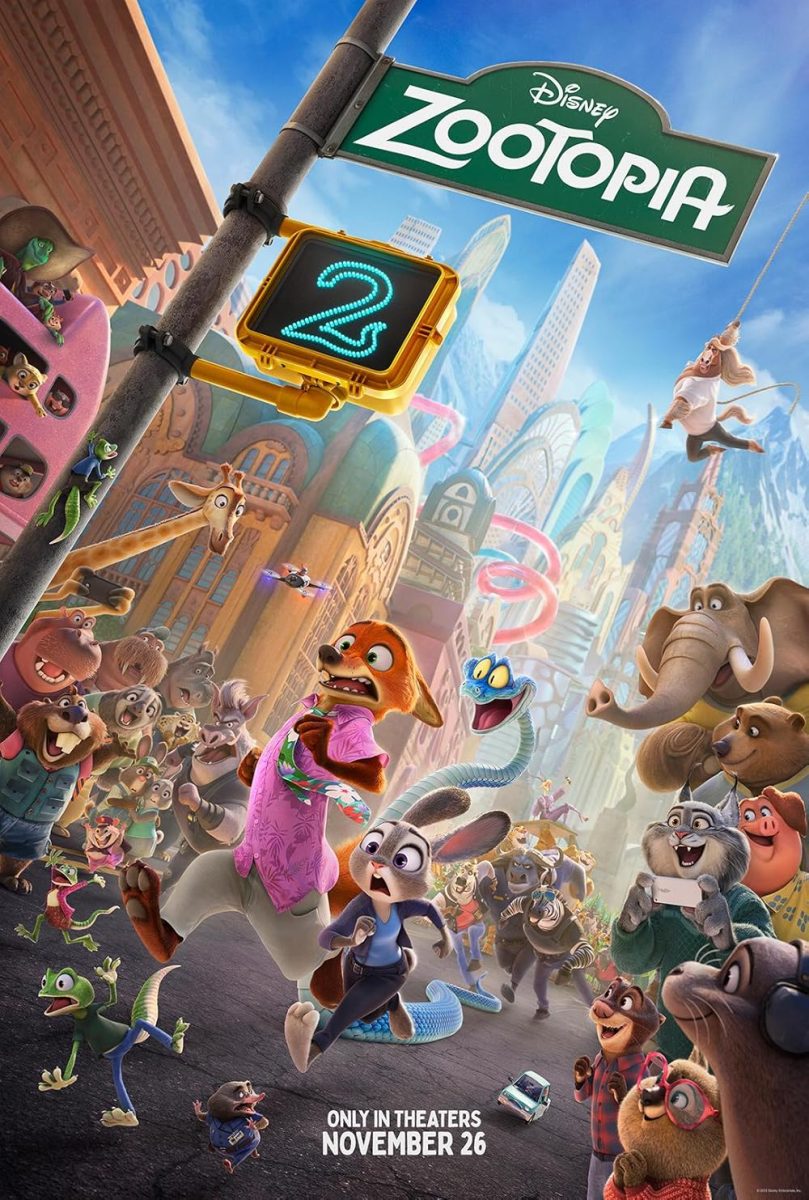
This Thanksgiving weekend, audiences returned to the world of Zootopia with its sequel, released by Disney, after waiting almost a decade since the first release in 2014.
This return to the mammal-dominated world provides a more fleshed-out story than the first film was unable to fit in, while also bringing in more beloved movie references. However, the standout part of the film that’s responsible for its smash-hit opening weekend at the box office is the sophisticated social commentary it delivers to the youth of today, tackling issues like racism, gentrification and the effects of propaganda head-on with a heartfelt and engaging plot that I believe captivated audiences of all ages.
Jumping right back into the story a week after the first film’s ending, it follows Judy Hopps and Nick Wilde as the Zootopia Police Department’s newest crime-fighting duo, coming off their hype train after exposing Zootopia’s previous mayor, Dawn Wellbether, for her crimes against predators of Zootopia.
For context, Dawn the lamb played as the main antagonist in the last film, where she took part in a scandal of drugging predators of Zootopia, turning them into rabid animals in an effort to drive them out of Zootopia.
The compelling aspect of the first film that carries on into this expansion is how these stories can be mirrored towards issues we’ve seen in real life.
Dawn’s acts of drugging and propaganda hold extremely close ties to President Ronald Reagan’s scandal in the 1980s, where it was speculated that Reagan, alongside the CIA, conspired to have smuggled mass amounts of cocaine into black neighborhoods across the U.S. The parallels in the film help raise awareness of real-life issues that are often forgotten through time. This scandal can be seen as a foundation for the systemic racism we see today.
Comparing this epidemic, it’s clear that “Zootopia” intended to give us a feel-good story, teaching the youth of today that true crime can be fought and our elected officials must be held accountable. This success story also shows the consequences of not taking action, sparking awareness about the issue of the alleged manufactured crack epidemic and its consequences after its release.
“Zootopia 2” dives right back into the same topics, with the audience following our crime-fighting duo Judy and Nick on the case of a wild snake that’s been spotted in Zootopia. We then learn that for decades, snakes haven’t been welcome in Zootopia due to prejudice and past incidents of snake violence and bites.
Through their detective work, we see in real time the effects of propaganda and how easy prejudice develops, as even Judy fears the snake will kill them if caught.
It isn’t until almost halfway into the story that we learn the truth of this elusive snake – he may not be the real antagonist of the film. In reality, he’s the victim in this story, trying to make things right and expose the dark reality behind the mechanisms that drew Zootopia to fruition. This unfolds as we learn of the Lyxnly family, the powerful elites who control Zootopia and are in cahoots with the city’s government officials.
Through manipulation and blackmail, the Lynxley family exposes the dark secret that they’ve been slowly expanding their habitat, driving out species from Zootopia to expand their land ownership.
As Judy and Nick learn the reality of their situation, they finally unite with Gary De’Snake to find the sacred doctrine that his ancestors created with the plans to create Zootopia, a world where all animals can live comfortably and equally in their own habitats – a plan that the Lynxley family has been claiming as their own for generations to preserve their status and power.
What makes this expansion so compelling is how it mirrors the war in Gaza, as well as the creation of Central Park in New York City, a story that’s been erased by time.
The parallels to Gaza are clear, as one globally elite family controls Zootopia, holding the power to occupy and invade others’ land and claim it was theirs.
The most controversial commentary the film provides to the youth of today is what I believe to be representing the story of Seneca Village, a predominantly black neighborhood full of the first freed slaves in New York City that was destroyed and drowned out to create Central Park.
The similarities are clear to me: instead of being drowned out by water, Reptile Ravine was snowed in by the Lynxly family to hide the community’s erasure, just like how Central Park became a tourist attraction that hides its dark history.
“Zootopia 2” offers an incredibly stunning film, a breath of fresh air in an AI-dominated industry. It reminds audiences of what real cinema used to be and how it’s important for today’s youth to be exposed to stories like this.
Straying away from the recent soulless animation aimed at holding attention spans, this film provides a compelling, heartfelt story that both children and adults can enjoy and value. In the decline of American cinema, children’s movies like these remind us of why the theatrical experience is, and why we must support this dying industry while we can.