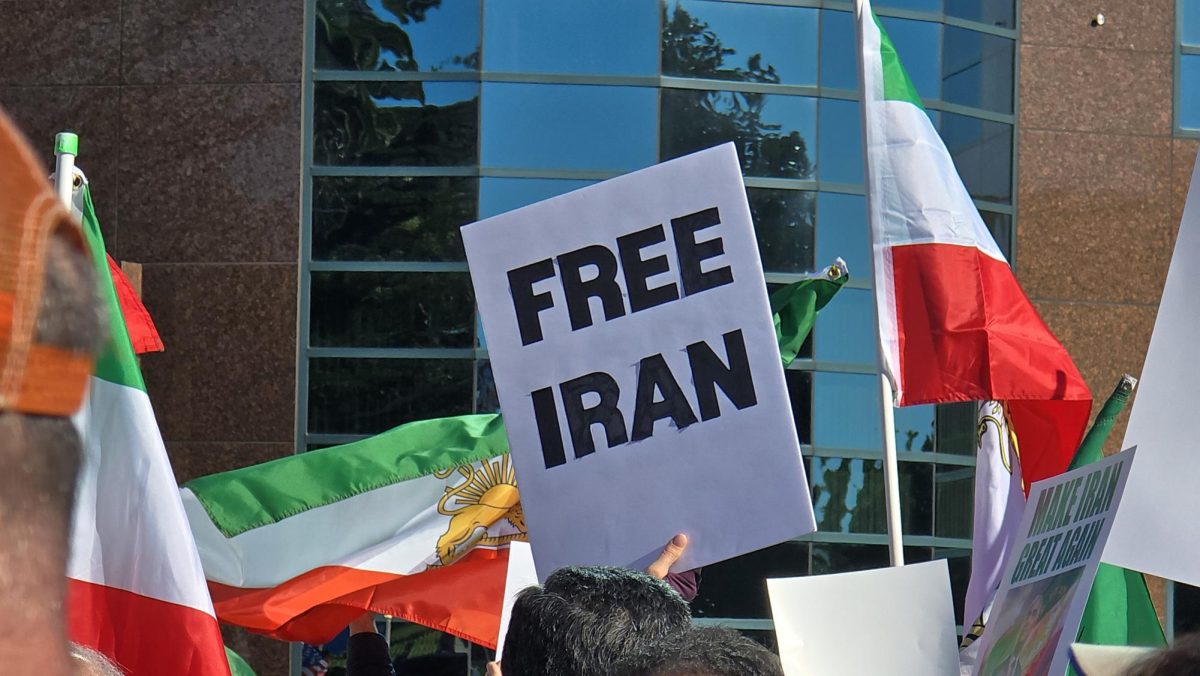
Mahyar Ashk, a CSUN student raised in Iran and president of the Iranian Student Association (ISA), typically calls his grandparents in Iran every night, as well as checks in with his friends who live there. Now, he has no way of knowing when he’ll be able to talk to his grandparents next, or if his friends are even alive.
As a result of Iranian civilians protesting against Iran’s current regime, led by Ayatollah Ali Khamenei, the Iranian government has cut off all internet access since Jan. 8.
The protests call for an overthrow of the government and come after what protesters say is a long history of oppression and violence from the regime. As of lately, however, both the protests and the government’s violent response to them have reached an unprecedented magnitude.
“This is the one time the whole country has come together and been like, ‘enough is enough,’” said Kyana Panoussi, a CSUN alumnus.
The blackouts may seem to serve as a sort of punishment for the protesters, but ultimately, it’s more than this. Iranians state that the blackouts are the government’s tool to prevent the world from seeing what’s truly going on inside the country.
“It’s hard to really tell how many people they’ve killed,” Ashk said in reference to the regime killing civilians since the start of the protests, one month ago.
Sporadic pockets of internet access allow Iranians to share glimpses of the brutality the regime is inflicting, often sent to family members in America. However, there is still much uncertainty around the extent to which people are being killed.
Khamenei puts the death toll at around 3,000, but CBS reports that it could be as many as 20,000, with Iran International estimating deaths to be more than 35,000.
“My friends in Iran that I’ve contacted very recently told me that it has to be definitely more than, like, 50,000 people,” Ashk said.
The lack of a confirmed number is due to the blackout limiting the spreading of information, along with thousands of deaths still being “investigated.”
A CSUN student using the alias D.S. receives photos and videos amid intermittent internet connections from various contacts in Iran and reported that each morning, water is used to wash the blood off the streets from the previous night’s protests. D.S. wished to remain anonymous out of fear for their family’s safety.
D.S. compared the entire last month to the movie “The Purge” and believes the government is getting its revenge on the protesters.
“This whole thing is like you could basically kill whoever you want that’s protesting, and you get away with it,” D.S. said. “There’s videos where people are running away, and they’re just shooting.”
D.S. and Ashk both claim that the regime’s protocol for identifying bodies is contacting the family and demanding that they pay a ransom to receive their loved one’s body. Families allegedly have to pay extra for each bullet that was used, while also being required to bring a pastry as a “thank you” for providing the body to the family.
According to Ashk, the unidentified or unclaimed bodies have a different fate.
“They put the bodies in trash bags, they pile them on top of each other, and they bury them in mass graves, stacked on top of each other,” Ashk said.
CBS confirmed this with snapshots of a 16-minute-long video showing bodies lined up at a morgue.
Both D.S and Ashk stated that the Iranian government celebrates the number of protesters they’ve killed, with some government officials mocking the victims. D.S. also described seeing a video of a man dancing on top of the bodies of civilians he had killed.
“Unless you have family in Iran, you’ll never know,” said D.S. “The media will never tell you.”
Panoussi felt that people in America seem to be generally unaware of the immense violence of Iran’s regime, and said some people think it’s “Western propaganda.”
“I mean there’s two sides to every story … but for this one, I don’t think there should be two sides,” Panoussi said. “I don’t think anything justifies governments killing their own people.”
This leaves Iranians pleading for Americans to be more aware and to get involved.
“Compared to what we saw with the Free Palestine movement, we’re not seeing that much happening about Iran,” Ashk said.
Ashk added that if the massacre of Iranians alone is not enough to gain attention among Americans, then they should at least be aware of the threat that they themselves face.
“If this regime continues to exist, they’re not looking for a nuclear deal, … these people will definitely go back and create a nuclear weapon, and their first target is either Israel or the United States,” Ashk said. “They’re not diplomatic or democratic people; they’re really violent, and they don’t care about humanity.”