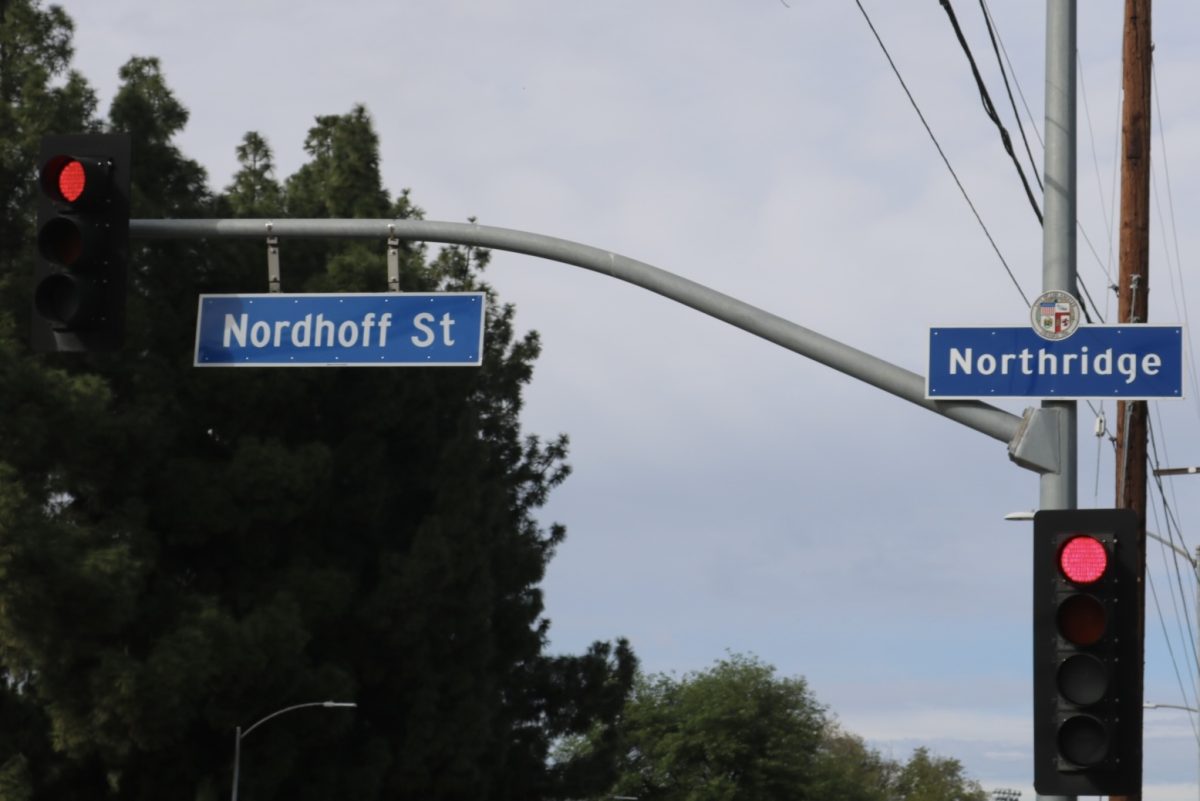
As Sergio Lopez gets ready for his 8:30 a.m. classes, he manages his time well. As a commuter student, he hits the freeway at eight o’clock. As he gets off Interstate 405 and nears campus, Lopez waits. And waits. And waits.
Commuter students who take Nordhoff Street towards CSUN encounter heavy traffic during the early morning prime hours at the Zelzah Avenue intersection right in front of campus. This traffic extends their morning commute, often leaving them late to class.
“I get here like 10 minutes late to class,” Lopez said. “[I wait] around eight to 10 minutes, that takes the majority of my commute here.”
CSUN is primarily a commuter campus, and having an intersection that adds an average of nearly eight minutes to students’ commute is costly to students and staff.
According to data gathered by The Daily Sundial, the intersection was found to be inefficient for the morning commuters.
“This is an unnecessary bottleneck,” CSUN Department Chair of Urban Planning Dr. Toker Zeynap said. “It can be adjusted so that, you know, you don’t spend your eight minutes, almost 10 minutes every morning, sitting in a traffic light.”
When looking at the prime morning arrival time, it would be expected that the green light time would be extended to accommodate arriving students. However, that is not the case. Instead, the time for a green light is actually shorter.
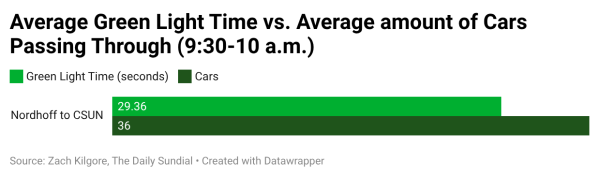
There is only a specific number of cars that can travel in the allotted time given for each green light. Though, there is less time for a green light with more traffic en route.
The street is backed up with cars that are unable to pass under the 30-second green light, sometimes amounting to over 60 cars in tow. It would take nearly two full traffic light rotations to keep a steady flow of traffic and accommodate the extreme amounts of incoming students, which is currently not the case.
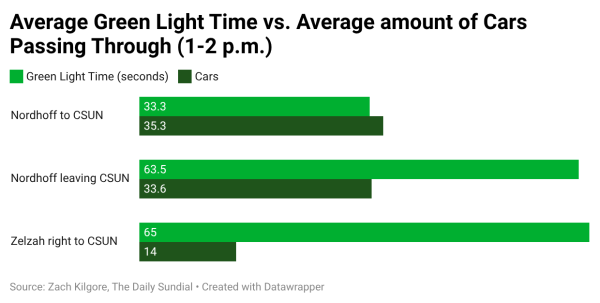
“I think … it can be coordinated in a way that it’s more responsive to the actual use,” Zeynap said. “I’ve been paying more attention to it. Now, as I’m making the turn [on Zelzah Avenue], I’m looking. It is concerning.”
If the green light were hypothetically doubled in time, traffic would flow at a much steadier pace, whilst still allowing cars to drive opposite of CSUN.
With a current enrollment of more than 36,000 students, 91% of whom live off campus, commuting is a central part of daily life at CSUN. Because the vast majority of students rely on traveling to and from campus, they expect this commute to be as efficient as possible. However, the current traffic conditions suggest that this standard is not being met.
“It’s always the most time-intensive part of the commute,” Lopez said.