Wafts of saffron and rosewater emerge from a hot concoction of toasted flour and sugar for a dessert with deeper meaning.
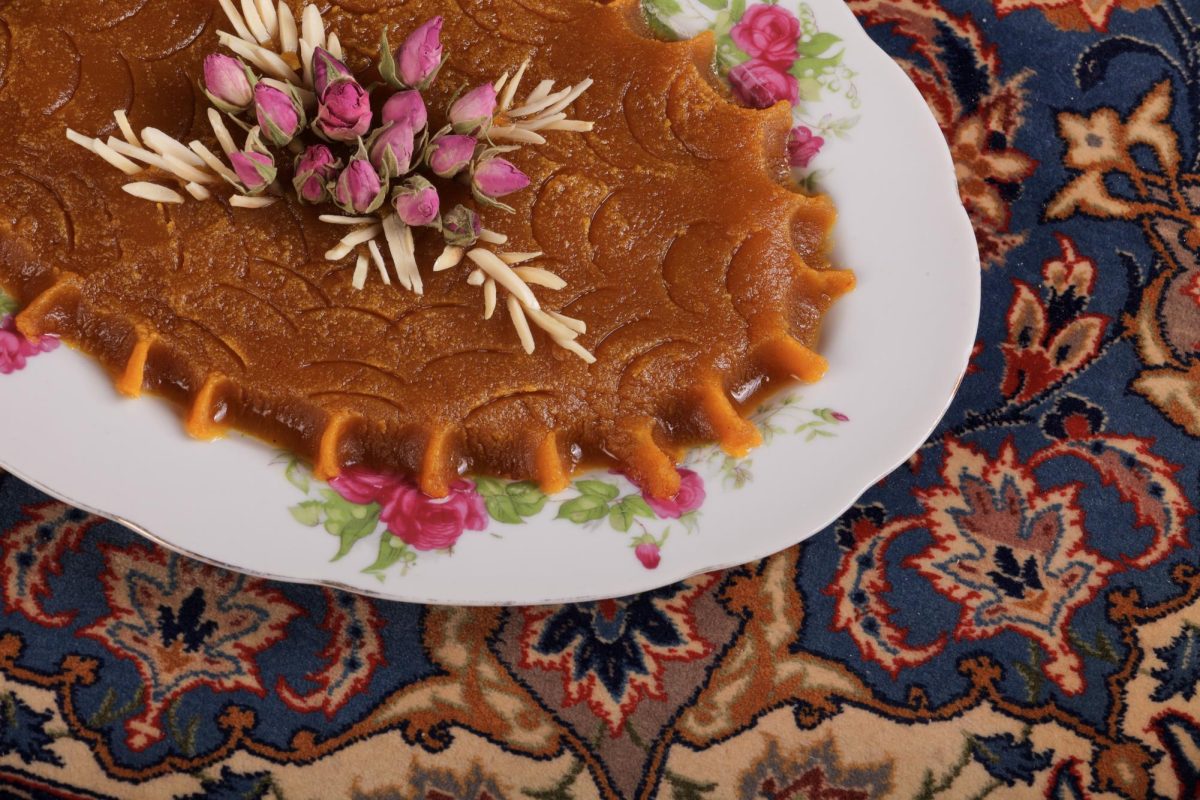
Persian halva is an Iranian sweet traditionally made with flour, sugar, rosewater and either oil or butter. Fragrant saffron and ground cardamom pods are added for taste, and crushed pistachios, almonds or coconut may be used as garnish.
According to Azita Mehran, author of the Persian food blog Turmeric & Saffron, halva is a common sight during Iranian religious holidays and a traditional offering at funeral services.
Consequently, halva carries a meaning that reaches further than beyond simply satisfying a sweet tooth. This sweet treat can offer solace in times of grief and stand as a symbol of enduring family heritage.
Mehran’s article brings to mind her mother’s habit of making enormous platters of halva. She describes halva as indulgent and comforting. She also mentions that halva does not have to be saved for special occasions.
First, create a simple syrup with sugar and water. Rosewater, ground cardamom and saffron are added after the syrup is prepared. Then, the mixture is poured over the toasted flour.
In Mehran’s recipe, the flour is toasted separately in a pan over medium-low heat until lightly golden brown and fragrant. This takes about six to eight minutes.
Once stirred into the flour, the oil or butter cooks over low heat for an additional 10 to 12 minutes. Warm syrup is gradually mixed in until the halva becomes thick and turns into a paste.
Below is another Persian halva Facebook Reel video shared by “Cooking With Yousef.” Social media has the power to help spread the love for this delicious dessert globally.
According to Mehran’s Turmeric & Saffron recipe, Persian halva can be prepared with the following ingredients:
For the syrup:
1 ½ cups sugar
1 ½ cups water
¼ cup rosewater
¼ teaspoon ground cardamom
¼ teaspoon powdered saffron dissolved in 2 tablespoons of hot water
For the halva:
2 cups whole wheat flour, sifted
1 cup vegetable oil (or unsalted butter)
For garnish (if allergic to nuts, skip this part):
Slivered almonds
Chopped pistachios
Shredded coconut
Once the halva is just right, spoon it onto a serving dish and level it with the back of a spoon. Slivered almonds, chopped pistachios or shredded coconut can be sprinkled on top of the finished halva.
Mehran also points out that halva can have varying textures. She informed one of her readers on her blog that by adding more syrup, the halva can become smoother and less dry.
Preparing the halva in advance is also an option. Mehran states that it can also be frozen, allowing some flexibility with when the dessert is served.
Although Persian halva has few ingredients, it requires finesse and attention to detail to perfect. Its silky texture, aromatic ingredients and embellished appearance allow the dessert to stand out.
Halva also serves as an example of how the hard work and preparation of the food, combined with the act of eating it, lend the dish great meaning.
The taste, look and history of Persia all blend together when eating Persian halva. Made with simple ingredients, the final dessert is rich with flavor, memories and tradition.