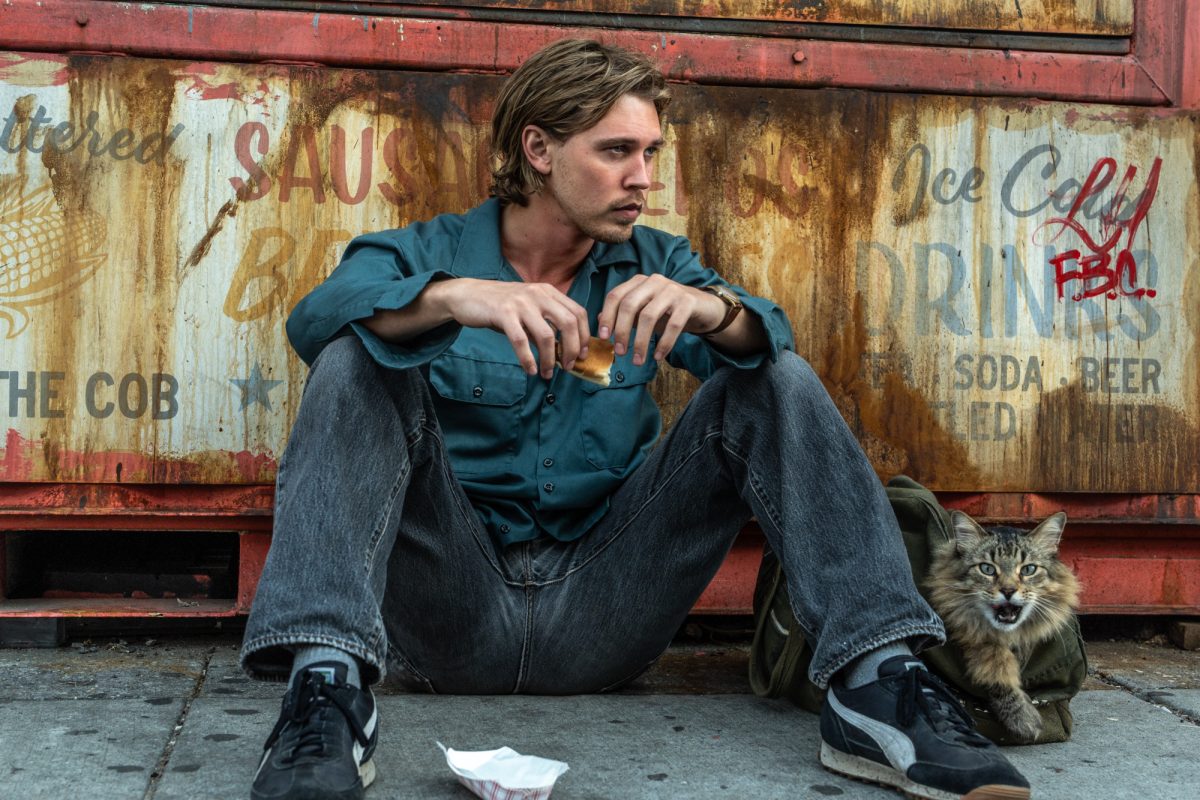
Award-nominated filmmaker Darren Aronofsky’s latest film, “Caught Stealing,” starring Austin Butler, was released on Aug. 29. The film takes place in the 1990s on the Lower East Side of New York, where a former baseball player turned bartender is tasked with watching his punk neighbor’s cat for a few days.
However, chaos erupts when Hank Thompson, played by Butler, is unexpectedly caught in the middle of a motley crew of threatening gangsters, leaving him with no choice but to run for his life.
The film is based on the acclaimed novel written by novelist Charlie Huston, who had been working endlessly to get his book adapted into a screenplay and greenlit for studio production 18 years ago, according to The Mercury News. Huston had pitched the screenplay to Aronofsky, who had no interest in the screenplay at the time. At that point, the script went through a Hollywood shuffle.
For those who aren’t major film buffs, Aronofsky is an American director, screenwriter and producer who has directed “Requiem for a Dream” (2000), “Black Swan” (2010), “Mother!” (2017), “The Whale” (2022) and so on. I was surprised to see Aronofsky shift from his usual melodramatic, surreal and disturbing style into a film that’s more comedic and crime-driven.
He briefly explains the reasoning behind this shift in an interview with Collider, saying, “…this is really an attempt by me just to make an entertaining film. As a movie goer, I was sort of noticing my own picks and the needs I kind of had in my life, which is, I really wanted something refreshing, something new, something different that was fun.”
Luckily for Aronofsky, Huston crossed paths with him three years ago and he regretted that the two never got to work together. As a result, Huston asked Aronofsky to read the script, and they both developed it into an entertaining, action-packed crime film.
I will admit, I had my doubts – like any movie-goer before stepping into the theater – and thought the film was going to flop. However, the film definitely surprised me in the sense that certain scenes were gut-wrenching and unsettling, and it was complemented by a good amount of humorous dialogue. There are some dream sequences, which in some cases can be poorly executed, but this film pulled it off due to its relevance to the story and our main protagonist, Hank’s character.
There’s also a slight twist that occurs during the film’s climax, which was pretty surprising in my opinion. If you had already watched the movie and caught that before the twist was revealed, props to you. However, if some of you haven’t seen it yet, definitely watch it and pay close attention to catch subtle clues.
When it comes to the overall climax of the story, I felt like the payoff, ironically but brilliantly enough, concluded the main conflict. Hank goes through a red and blue pill situation where he’s given two choices: own up to your mistakes or run the hell away from it.
If you’re wondering which pill he takes, well, you will have to watch the movie to find out.
Even though the plot drives the story, it’s the performances that also add meaning to what’s being showcased, making the ride worthwhile. It was refreshing to see Austin Butler portray a character that’s more raw and vulnerable in comparison to the previous characters he’s played in the past. He portrayed Hank Thompson’s emotions authentically and believably, which allowed me to truly connect with his character.
Besides Butler’s compelling performance, Zoe Kravitz as Yvonne also did an impeccable job – I can tell she gravitates towards confident and gritty characters, which she plays very well. Even her on-screen chemistry with Butler was natural and engaging. They did a pretty good job of analyzing and understanding their characters’ wants and needs.
Although I can’t give Butler and Kravitz all the credit, there was one particular actor who truly stood out to me, and that was Tonic the cat’s performance as Bud.
His character was feisty when it came to strangers he wasn’t familiar with, but he had a soft spot for our baseball-loving protagonist. I would love to see Tonic the cat in more productions, hopefully soon. There were also solid performances by Regina King, Matt Smith and Griffin Dune.
But what’s a cast without the crew?
The production did an excellent job bringing the audience back in time to 1990s New York. The grittiness of the Lower East Side suited the film’s style, and it made sense because crime rates on that side of New York were higher back then. The rawness of the vibrant city was immersive, and it helped that Aronofsky, a New York native, was able to capture the essence of that time period.
Also, props to the Academy-nominated cinematographer, Matthew J. Libatique, another New York native, who skillfully captures the essence of the dynamic city through bold and striking close-up shots.
I admire Libatique’s trademark, the use of close-up shots, because they create a sense of unease, making the character feel isolated. I could see every subtle detail of an actor’s facial expression, which connected me to their character. The lighting even looked natural and nuanced; it wasn’t oversaturated or unappealing, and it maintained its realism and nuance.
“Caught Stealing” is an entertaining film about trauma, guilt and the importance of overcoming fear. It explores themes of love and redemption, inspiring us not to take for granted the people in our lives. You can run away from fear your entire life, but you can’t hide forever.