The CSUN men’s basketball team opened its season on Nov. 3 with a blowout against Nobel University. Apart from the rowdy front row of the student section hurling remarks at the visiting team, one person caught the eyes of everyone in the gym.
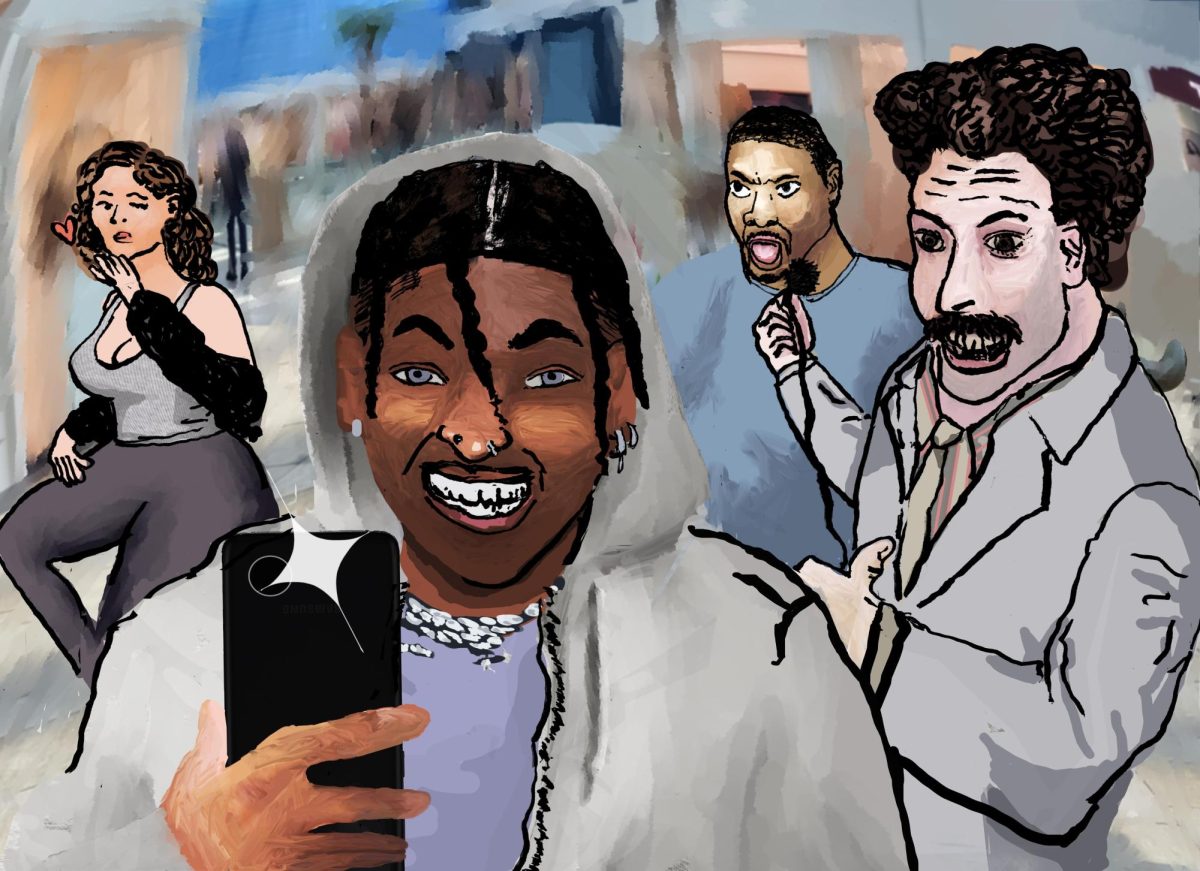
Dressed in matching a jeans and jacket set that was glittering like a disco ball, SwagBoy Q was certainly hard to miss. When he was announced as a celebrity guest, most people over 25 looked at each other, slightly confused, or shrugged it off as just another LA clout-chaser with a bit of hype.
However, the kids section went crazy with cheers when the illustrious influencer stood up to bathe in the admiration of his fans.
At this point, I was entirely oblivious to the existence of this internet character. I had noticed his eye-catching outfit and his courtside seat, however, the two-sided reaction when his name was called quickly piqued my attention.
I did not have a hard time finding his Instagram page, with over 3 million followers, and his TikTok, with close to 30 million followers. His content was both strangely repulsive and fascinating.
Scrolling through the mountains of short-form videos he had released in just the last year, I quickly caught on to two distinct “genres” that SwagBoyQ used to great success.
The first genre of videos usually features 20-something-year-old girls in one way or another. While that itself is certainly no need for concern, the way in which they are portrayed might be.
They are usually scantily clad and put into position with varying degrees of sexual ambiguity. A hugely popular format on his channel is the so-called “escalator rizz,” where SwagBoyQ uses his looks and charisma to charm women in public places.
It should come as no surprise that these women usually turn out to be adult content creators and that their interest in him is probably as staged as most of the videos. While this may well be a frugal business partnership between both parties, one does have to wonder about the moral implications of such promotion.
“Rizz,” a catch-all term for everything from charismatic behaviour around girls to pick-up artistry, seems to be the defining topic of these videos. These videos and their success seem to reveal some conditions of their viewers. They portray a fantasy of “easy” women who will offer themselves up willingly to the sexual charm of the creator.
The decreased frequencies of sexual encounters for Gen Z, and their lack of social and romantic connections, are well-documented issues. These factors, combined with the fact that most of the skits take place in public spaces rather than digital ones, should at least partially explain why these ideas seem to resonate with a younger audience.
The second, even more interesting “genre” I was able to identify is the “fake tourist prank.” These videos are set in America’s secret places of longing – the aisles of Walmart and Target.
Between never-ending rows of shelves, SwagBoyQ hunts for unsuspecting victims. His system is simple: approach a stranger, ask him for directions through a fake translator app, which will turn the harmless response into a racist remark. The punchline is the victim’s baffled and embarrassed reaction, as their words get turned into an insult using anything from watermelons to cotton fields.
To understand this type of humor, I sought out the help of two great Intellectuals: Borat and Baudrillard.
At first glance, these videos seem to utilize the same basic formula that Sacha Baron Cohen made world famous through his iconic Kazakh character. He put regular Americans into completely absurd and highly socially or politically charged situations to create phenomenal satire.
However, he and SwagBoyQ differ in one essential way – when Sacha Baron Cohen has a Rodeo audience applaud the idea of George W. Bush drinking Iraqi blood for America’s “War of Terror” or discusses the best guns to kill Jews with a salesman, the punchline is the social norms and structures, the prejudices and the secret motivations that lead to people playing along with or even encouraging this highly absurd character.
The satire targets real issues perpetuated by real individuals.
SwagBoyQ’s videos, though they may be similarly absurd, make the prank victim into the punchline instead of creating humor by revealing hidden norms and structures. While racism and prejudice do still pose major issues in American society, none of the people actually ever said anything racist.
This is where French sociologist Jean Baudrillard comes into play. He argues that in a media environment like our own, distorted and falsified depictions of reality become more real than the facts they represent.
The “fake tourist pranks” use the very real issue of racism to make a fool of the victim, but it is in a form that is both artificial and hyperbolized. This hyperreality creates millions of likes and views for the creator, while the underlying issue that creates the awkwardness is essentially parodied.
Reading Baudrillard these days will cause plenty of discomfort. Part of that is because his and other poststructuralist works are notoriously unintelligible. Their content, once deciphered, is eerily reminiscent of far too many contemporary phenomena. His critiques of modern media can easily be applied to much of today’s content industrial complex and the inescapable assault through ads and marketing that permeates much of the U.S. in 2025.
As he describes how symbols move through stages of abstraction, until the final simulacrum has no reference to reality left, one can not help but connect the theory to AI art. Just like the “fake tourist pranks,” pictures generated by Sora and many other models may appear meaningful, but lack any connection to lived experiences or real phenomena.
I highly doubt that SwagBoyQ, or most other creators in this particular content niche, are aware of the underlying tendencies in American media culture that their content reveals. They found an effective strategy and were encouraged by the enormous engagement that this type of entertainment generates.
There are many ways to become a celebrity guest at a college basketball game. While the French poststructuralists would certainly have a lot to say about most of them, they were never showered by the cheers of their teenage audience when being announced at halftime.