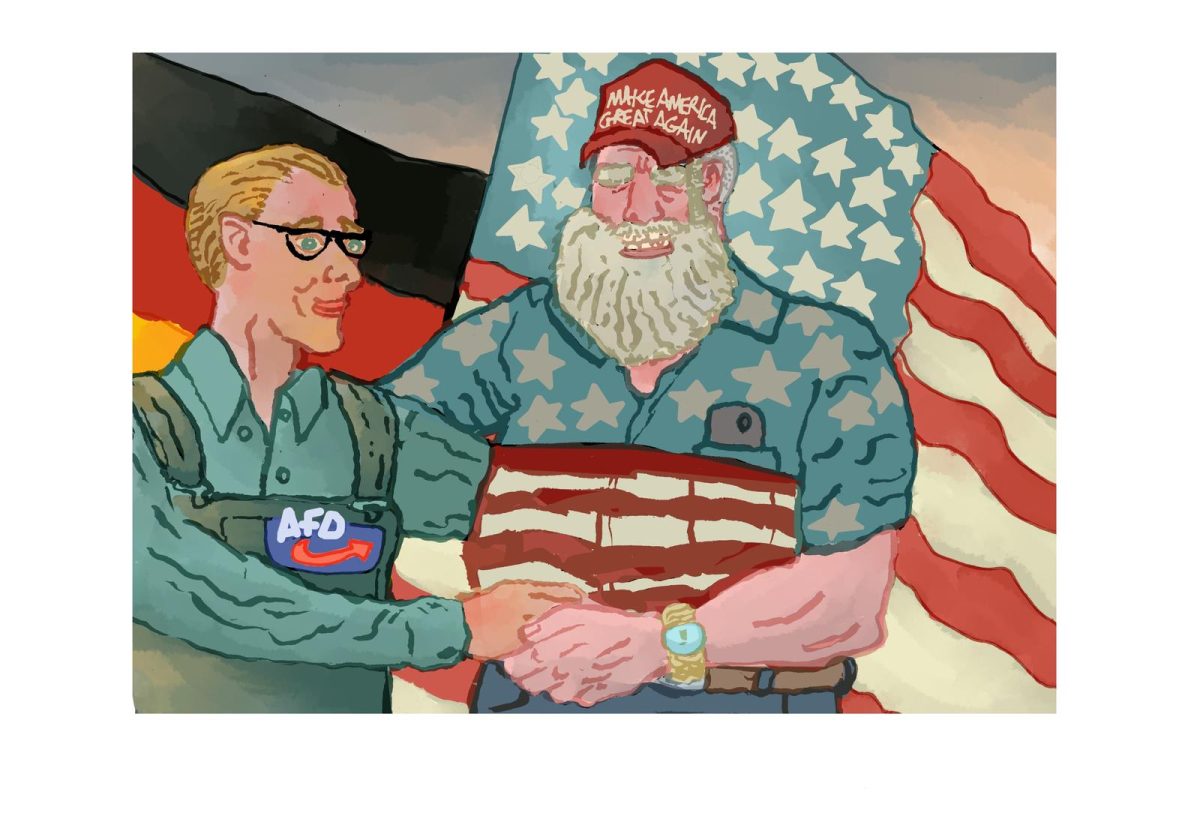
The Alternative für Deutschland (AfD) is a far-right party that has polarized and mobilized German politics in a largely unprecedented way since the end of World War II.
Their talking points include many classics of the right that American readers will surely recognize from their own country’s recent history, especially surrounding immigration. Similarly, they combine this pillar of their party’s identity with a mix of new and old conservative talking points that are best understood through their name.
They present themselves as an anti-mainstream, anti-establishment alternative for Germany that proudly rejects anything that their base views as negative results from the workings of “the elite.”
Their wrath is pointed at institutions – political, public, economic and social alike. That includes anything from tech-overlords to European Union overreach, mass immigration, the Speech Police and a whole host of figures blamed for conspiracies, ranging from Great Replacement to QAnon.
The demographic makeup of their base is unsurprisingly quite similar to that of the red party in America. They attract men – particularly those between the ages of 18 and 24 – voters in the working class, unemployed voters and voters without a college degree. East Germany has swung the furthest right, with the party achieving its first state victory in Thuringia.
The story of this former Soviet satellite state turned into part of a Western free-market, capitalist powerhouse helps illuminate the current state of the U.S. and what areas have ended up burning red the brightest in recent years.
After World War II, Germany was divided into the Federal Republic of Germany (FRG), allied with the U.S., France and Great Britain, and the Democratic Republic of Germany (GDR), allied with the Soviet Union. The conflicting economic models of the Cold War era would see those brother states take wildly different approaches to rebuilding their war-torn countries. West Germany achieved its “Wirtschaftswunder,” or economic miracle, with a bit of help and funding from the American Marshall Plan.
On the other hand, East Germany’s rebuilding took the socialist approach. Following the Soviet Union’s model, the rebuild involved widespread nationalization of private goods, the implementation of a planned economy and a focus on producing goods needed primarily in the Soviet sphere of influence. This dependence would create major problems for the GDR later on and fuel public disenchantment with the regime.
The years following the fall of the Berlin Wall in 1989 are instrumental in understanding the rise of the AfD in East Germany. It was a moment of overwhelming joy and optimism for the roughly 16 million people suddenly free to leave behind the shackles of their defunct surveillance state. The reunification of the country under a moderately regulated social market economy promised prosperity and progress previously unheard of. This seemed like a free pass into the developed world for a region where people famously had to apply for a chance to buy a car at the birth of their children, with it ready at their 18th birthday. These promises were not kept.
The “Treuhandanstalt,” or trust agency, tasked with privatizing large parts of the GDR’s former national economy got tangled up in a web of logistical issues and corruption. This, combined with the fact that most of the companies were sold off to West German and foreign parties, created a righteous feeling of economic betrayal in the East, as the profits from the state economy they had helped build were suddenly funneled away from the region. 35 years after the reunification, the West is still more prosperous, educated and profits more from Germany’s overall economic strength.
At this point, some of these issues should sound familiar to U.S. readers. London School of Economics scholar Jonathan Hopkins argues that Donald Trump’s victory in 2016 is best understood through an economic lens.
Many of the deindustrialized areas that ended up swinging red the hardest tell a similar story to East Germany – one of economic betrayal. The unspoken contract of the neoliberal revolution of the 1980s promised prosperity and wealth beyond imagination for America by deregulating as much of the national economy and the international trade regime as possible. Implied in this promise was that the U.S. government would account for the financial havoc that a deregulated global trade championing comparative advantage would wreak on the industrial heartland of the country.
This promise was thoroughly broken. The new centers of the economy flourished – the coastal cities, where finance, tech, marketing and media pushed the U.S. GDP into feverish heights.
First, the shipyards, the coal towns and the Rust Belt collapsed under the pressure of international competition. Then, the American economy as a whole collapsed because of the utter failure of the financial sector to stay on top of its own practices.
To put the icing on the cake, the Obama administration – the champion of a social and progressive renewal of America – bailed out the banks with taxpayer money while ordinary people’s savings, home values and 401(k)’s vanished into thin air. The forces of the market and the government’s failure to punish those responsible for unleashing them had created a sense of complete economic betrayal in much of the U.S.’s former industrial heartland, similar to that felt by East Germans.
The AfD and Trump recognized these trends in the first half of the 2010s. They saw that the outrage against financial and governmental institutions had been produced by decades of neoliberal politics, increased social inequality, dying industrial sectors and an overall cultural shift to the left.
Both recognized the perfect window to gain political capital through the classic populist handbook: Present yourself as the only path to political representation for the outraged and the betrayed.
Both positioned themselves as antitheses to institutions more generally. They spoke loudly and vulgarly, used aggressive rhetoric and boastingly overstepped the boundaries of political correctness. They target liberal and progressive ideals that have been entrenched in many major institutions of public life, including the media, education and entertainment. They both have a fair share of simply paradoxical stances.
Trump regularly instrumentalizes Christian sentiments, but he cheated on his wife with an adult film actress. The co-leader of the AfD, Alice Weidel, is married to a woman while her party actively promotes the nuclear family as a core value of German society.
However, their followers could not care less. In either case, it seems as if a polished public appearance has become just another institution of the political sphere that is to be rejected outright. The openness of their abuses becomes just another insult to the elites for the bases of their movements.
This could also be the increased, sometimes equally paradoxical diversification of the MAGA coalition since 2016. What started as a mix of white working-class voters, conspiracy theorists, pro-business libertarians and fundamentalist Christians has evolved to include factions like Latinos for Trump, chronically online Gen-Z men, the MAHA movement and the tech right.
All these groups are, generally speaking, united by their disillusionment with various aspects of the last 20 years of U.S. establishment. The AfD has yet to build a coalition this broad. They lack the charisma of a figurehead like Trump. They are fighting hard to rid themselves of Nazi accusations, a familiar issue for MAGA, but one that looms larger given their country’s past.
Compared to the way Trump has influenced public discourse in the U.S., it also seems as if the ground for anti-institutionalism is simply less fertile in Germany.
The German people are frustrated with the mainstream parties. They feel that every election is an impossible task of choosing the lesser evil, but, by and large, they still believe in the integrity of their institutions and their democracy. This is the difficult, yet necessary way forward for America’s democracy.
In a country where a majority of the population feels like the government, the news, the universities and the economy are all working against them, all these institutions need to find ways to regain the country’s trust – not by fraud or deceit, but by a commitment to serve the greater good rather than themselves.