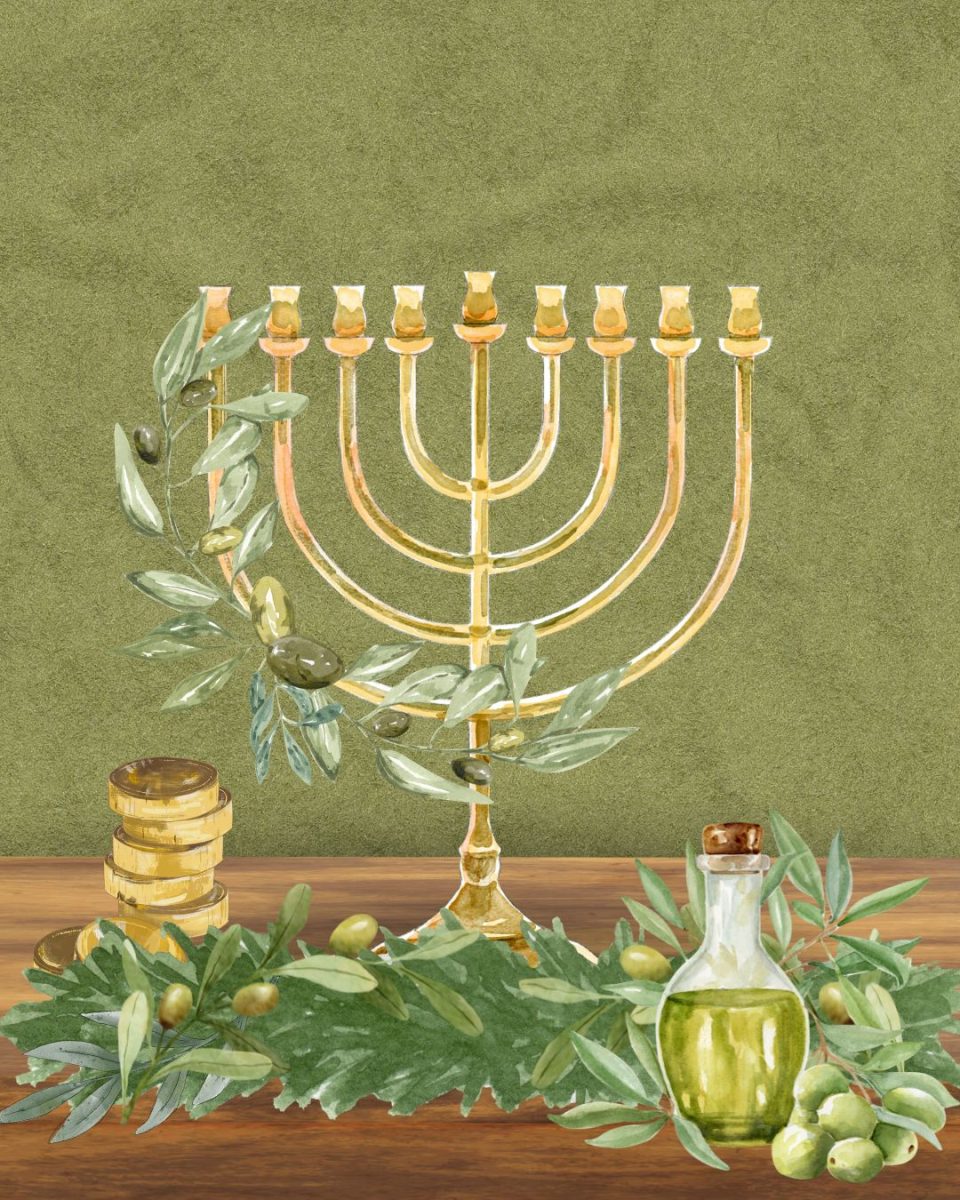
While we debate the spelling of Hanukkah (Chanukah? Hannukah?) and whether the right topping is applesauce or sour cream, we miss the most important question: Why is our holiday dominated by a single, politicized color scheme? The debate over blue and white is not about holiday decor, but about whether our most visible symbol celebrates the miracle of light or the flag of a modern nation.
Prior to World War II, the truth is that Hanukkah wasn’t a particularly huge deal. It was an important holiday, to be sure, but not the holiest or most important Jewish holiday, and surely not one that required as much hubbub as Christmas.
In order to assimilate, Hanukkah, due to its overlapping time period with Christmas, became a big ordeal in the U.S. It became a parallel holiday to Christmas, and big corporations quickly caught on. Hanukkah became Jewish Christmas.
According to Time, there is no pinpointed origin for blue and white becoming an identifying color scheme for the holiday across the U.S., though Hallmark was one of the first companies to catch on to this phenomenon.
The most commonly cited reason for these colors to be pulled is that in this same post-war Hanukkah rise to popularity, the State of Israel was founded in 1948. What easier way to find a Hanukkah color scheme than pulling from their flag.
Yes, blue and white are relevant in Judaism far beyond the creation of Israel. Blue dye is mentioned throughout the Torah as tekhelet, a dye derived from sea snails. It is used on tzitzit, ritual tassels or fringes often found on the four corners of the tallit, a prayer shawl. However, these colors had no historical connection to the Hanukkah story or its celebration. Their adoption for American Hanukkah coincided with this post-1948 nationalistic movement.
Throughout history and across different cultures and countries, Hanukkah was frequently depicted through warm, rich tones representing the yellow of the flame and the gold and silver of menorahs.
An early depiction of Hanukkah comes from the Torah. In Zechariah Chapter 4, a prophetic vision of Hanukkah, there is a gold menorah being filled by two olive trees, pouring golden oil into the pipes. The true, ancient colors of Hanukkah are found in the Earth, not in a flag.
Detaching Hanukkah from the State of Israel is complicated and nuanced, but so is the Jewish identity. It is fundamentally Jewish to seek peace and to be against bloodshed, especially in our name.
In the Tanakh, the Jewish Bible, the prophets share many anti-war sentiments, including naming Shalom, which means peace, as one of the names of God.
Isaiah Chapter 2, Verse 4 says, “They shall beat their swords into plowshares, and their spears into pruning hooks; nation shall not lift up sword against nation, neither shall they learn war any more.”
This Hanukkah, I hope for a future rid of bloodshed in the name of Judaism. I hope for a future where all people can celebrate the holidays safely, free from violence and anguish.
I will be having a Hanukkah full of the true Jewish fundamentals of kindness, humility and empathy. This year, I will be having a green Hanukkah. Not the secular green of a corporate Christmas, but the earthy green of the olive branch, the universal symbol of peace and the sacred source of light.