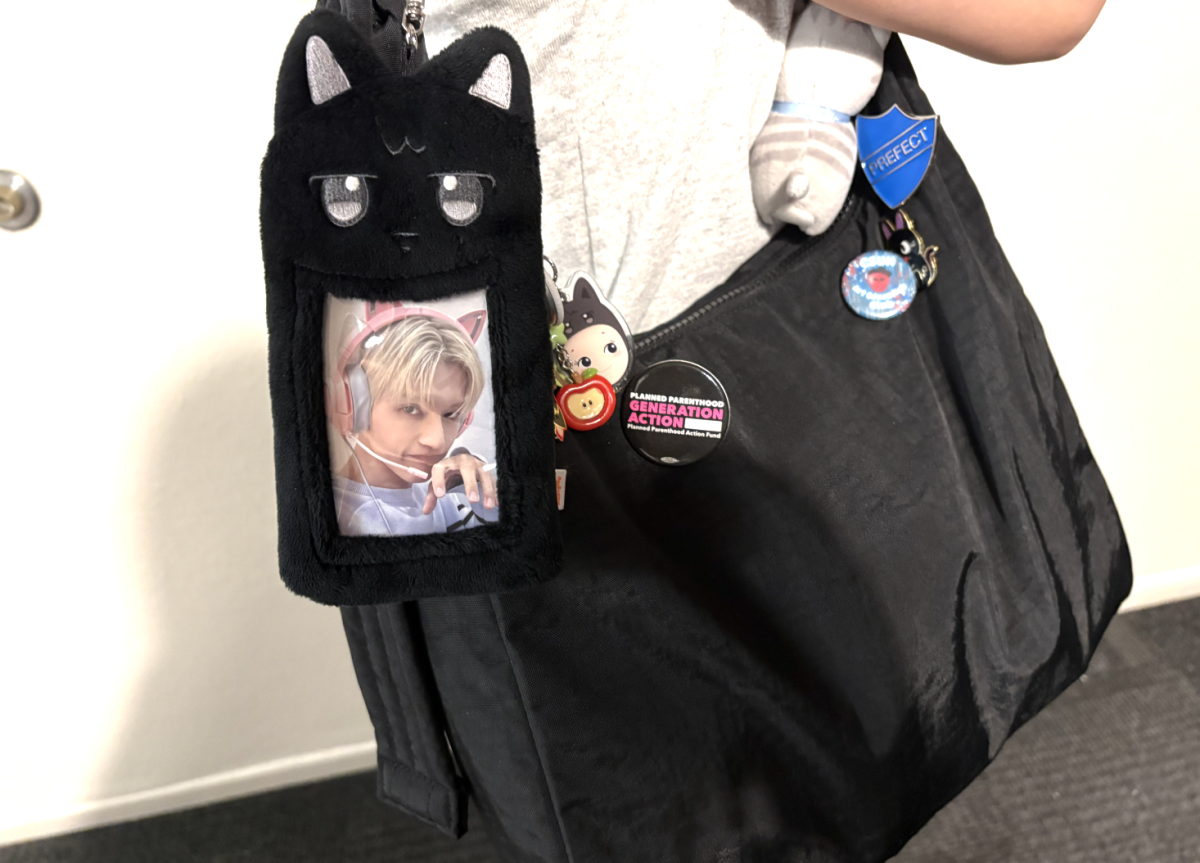
Have you ever seen someone walking across campus with a small picture of a K-pop idol dangling from their backpack or purse? The photo is usually about the size of a debit card, tucked into a clear plastic holder, sometimes decorated with stickers, charms or ribbons and protected like something precious. To someone unfamiliar with K-pop, it might look like a random trinket, but to fans it represents something more than just a picture.
Photocards are collectible cards, typically included as randomized “inclusions” inside K-pop albums and merchandise. Photocards first hit the K-pop scene back in 2010 when Girls’ Generation included randomized member cards in copies of their album “Oh!” What began as a small bonus item quickly became a defining feature of K-pop merchandising.
Unlike traditional Western albums, where inclusions are often nothing more than a CD, photocards introduced an element of chance – fans won’t know which member they receive until the album is opened. This randomness encourages trading, collecting and repeated purchases, transforming photocards from photos printed on cardboard into highly sought-after collectibles.
This trend reflects earlier practices in Japanese idol fandoms, where collectible items and fan events encouraged supporters to engage with idols, also known as oshikatsu – “oshi” meaning favorite and “katsu” meaning activity. Oshikatsu is a broad term used for activities in which fans support their favorite idols, whether through purchasing merchandise, attending concerts or publicly displaying items associated with them.
In K-pop culture, photocard collecting has become one of the most accessible and visible forms of this practice, allowing fans to express their love and dedication through small, portable objects. This dedication is often centered around a fan’s “bias,” their favorite idol within a K-pop group.
In larger groups, the odds of pulling a photocard featuring a specific member are significantly lower, making it especially difficult for fans to receive their bias through album purchases alone.
As a result, a bias plays a major role, with many focusing their time and money on obtaining cards of a single idol rather than collecting every member equally. When albums don’t yield the desired member, fans turn to trading, buying or joining group orders to complete their collections.
Ashton Miller, a junior at CSUN, whose bias is Felix from Stray Kids, owns photocards from a variety of groups, but his Felix collection stands apart.
“There’s a little section of my room that just is all Felix specifically,” Miller said. “Like, he has his own little binder.”
Miller estimated that the binder alone held approximately 60 photocards of Felix. According to him, focusing on a single member is both a personal and practical choice.
“If I’m going to put money into this hobby, I’m just going to put it towards my ultimate bias,” he said.
Rather than relying on chance album pulls, Miller buys photocards outright through Instagram orders, Japanese proxy services and resale platforms, allowing him to seek out specific cards.
As collectors become more selective about which photocards they seek out, price becomes an unavoidable factor in the hobby. Not all photocards are valued equally, and several elements can drive prices up. Visual details such as props – including food items, plush toys or accessories – often make certain cards more desirable. Limited releases, exclusive pre-order benefits and older albums eras can also increase demand.
One of the most debated factors in photocard pricing is what fans refer to as “member pricing.” Member pricing occurs when photocards featuring more popular idols are listed at higher prices than those of other members within the same group.
Miller has encountered this firsthand while collecting Felix. He explained that prices can vary significantly depending on the platform, with resale platforms like Mercari tending to reflect popularity more strongly. As a result, collectors are often forced to weigh their dedication to a bias against their financial realities of the hobby.
The impact of member pricing is not limited to one fandom or platform. Kevelin Barcenas, a junior at CSUN, has faced similar challenges while collecting photocards of V from BTS, one of the most popular idols in the K-pop industry.
Barcenas explained that collecting can be difficult when popularity often drives up demand and prices. Because of this, she often relies on group orders, which allows fans to claim specific members based on availability when buying albums in bulk.
Trading and viewing photocards creates opportunities for fans to connect with one another, especially in shared spaces like fan events and campus clubs. Barcenas explained how interacting with other collectors changed how she engaged with the hobby. Event organizers would encourage attendees to bring their own binders of photocards to share with others, which generated more interest for her.
“Seeing the actual photo cards, you get to see how they’re dressed, how they have their hair and everything,” she said.
Through these kinds of interactions, photocards can become more than collectibles, helping fans connect and recognize one another.
For some collectors, carrying photocards in public is another way to signal your love for an idol and your presence in a fandom. Mari-al Igama, a junior transfer student at CSUN, said she enjoys displaying her photocards on her bag using plush and crochet holders.
“I like to display a sense of my own hobbies,” she said.
Igama said that the visibility of her hobbies leads to deeper connections with other fans. Bonding with friends who share the same bias as her adds to the excitement of collecting, whether it’s spotting a rare photocard or finding one they had been searching for.
“We just get so excited together,” Igama said. “There is absolutely nothing wrong with finding joy in collecting things in general.”
The next time you notice a small photocard hanging from someone’s backpack as they walk across campus, it may be more than just decoration – it’s a small but meaningful way to show love for their favorite idol and share a personal interest with the world.