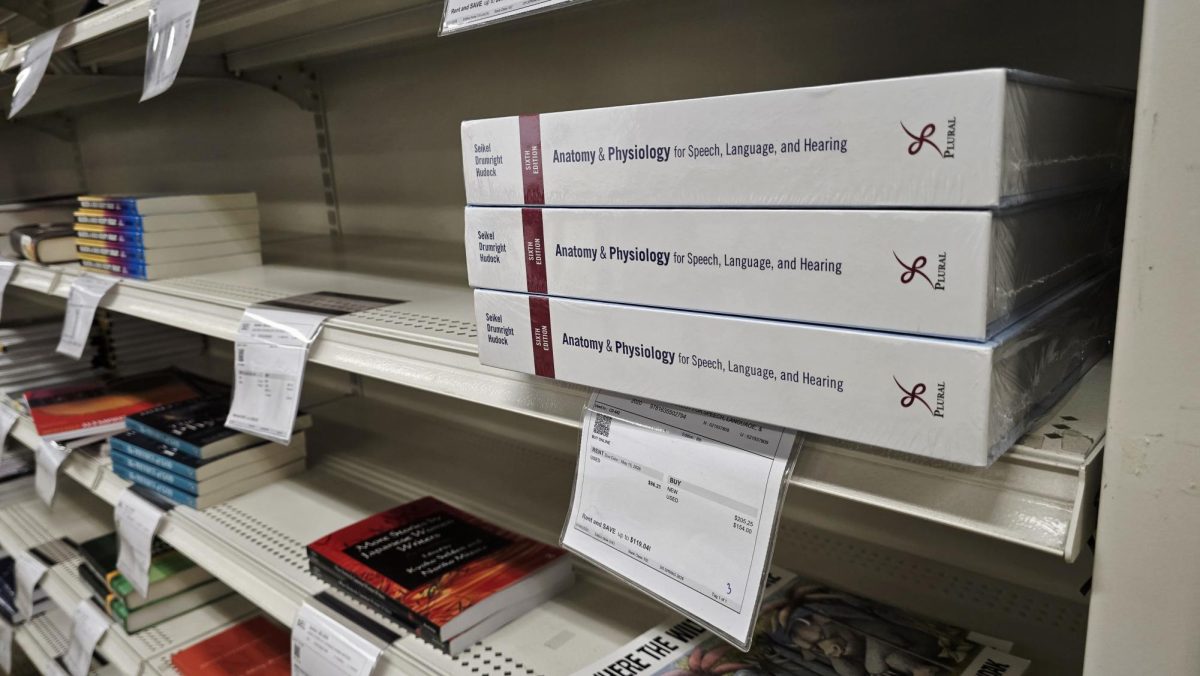
On top of the already high price of education, students at CSUN may find themselves struggling with textbook costs as well. Although purchasing textbooks and materials is expected when attending college, students claim that the cost of books still impacts how they budget for school.
Ashley Ortiz Ramirez, a junior majoring in entertainment media management, said expensive textbooks sometimes leave her with tough financial choices.
“Sometimes I have to find my textbooks online for free because I have financial restraints and need to prioritize other expenses before buying books,” she said.
Ramirez added that some required reading can feel redundant when notes and digital resources are already available. She recalled purchasing a textbook for approximately $100, only to find it was rarely referenced throughout the semester. She said her classmate buying the same book despite its limited use was both disappointing and a poor use of funds.
CSUN’s University Library’s Affordable Learning $olutions (AL$) program advocates the adoption of low and no-cost course materials. By providing resources and support for faculty members who are interested in decreasing textbook costs for students, AL$ is on a mission to lighten students’ financial load.
Open Educational Resources (OER) are one example of learning materials that AL$ suggests faculty consider, which students can access free of charge. Other alternatives to traditional textbooks include maximizing what the library offers, using e-books and digitizing select course materials.
According to the CSUN Cost and Financial Aid website, students can anticipate spending roughly $1,370 each year on books and supplies. Tuition, room and board, transportation and personal expenses add to the cost of attendance.
Students often spend money on textbooks continuously. Whether students spend that $1,370 in one semester or throughout the year, the price of textbooks can impact how and what they buy.
Sophomore child development major Joanna Baza estimated spending around $200 on textbooks this semester and said it was inevitable.
“I normally buy whatever my professor asks because I don’t want to fall behind in class, but prices are just ridiculous,” Baza said. “I always manage to make it work to buy what I need, but it is always a struggle every semester.”
The expenses, she explained, are compounded by other financial obligations.
Mechanical engineering major Schaya Sharifi said he spent about $400 on textbooks and digital access codes this semester and described the cost as difficult to manage.
“Sometimes I wait before buying materials to make sure I actually need them,” Sharifi said. “I try to avoid paying for books by finding free PDFs, because even renting can be expensive.”
He explained that digital access codes often leave students with little flexibility, forcing them to purchase required materials. This leaves textbook costs as one of his largest academic expenses each semester.
Jo Rojo, course material campus lead at the Campus Store, said textbook prices are often determined by publishers before reaching campus.
Rojo noted that MyCSUNDigitalAccess provides digital access to materials at a discounted price, saying there could be more classes offered in upcoming semesters.
“Our biggest [program] is the MyCSUNDigitalAccess Program, which gives students access to the digital book for the cheapest cost,” Rojo said.
Senior fashion design and merchandising student Kelly Santoyo said course materials costs vary widely depending on a student’s major.
“Fashion classes don’t always require textbooks, but materials are a different story,” Santoyo said.
She explained that fabric, supplies and equipment for sewing projects can range from $200 to $400, depending on the assignment. Unlike textbooks, those materials often have no cheaper alternatives because quality directly affects the final product.
While some general education courses offer rental or low-cost options, Santoyo believes that CSUN can do more to make books cheaper for all majors.
Students nationwide have similar issues. The National Association of College Stores recently released its 2024-2025 Student Watch report, which revealed that students spent an average of $341 on required course materials.
Student spending habits have changed over the years, but the cost of textbooks and course materials is still a driving force when it comes to the affordability of college. Here at CSUN, increasing costs continue to impact how students budget for class, what classes they take and how they access required course materials.