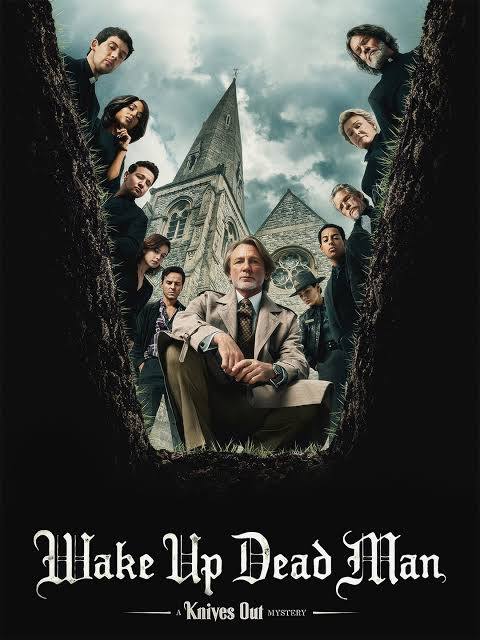
Rian Johnson’s third Benoit Blanc mystery, “Wake Up Dead Man: A Knives Out Mystery,” does not disappoint. It has captivated audiences with its locked-room time-shifted mystery, blending whodunit and howdunit.
After its limited two-week theatrical run, which began on Nov. 26, the film will become available on Netflix on Dec. 12. However, even with its limited run, the film earned a 92% rating on Rotten Tomatoes, while audiences gave it an even higher rating of 94%.
The film is the third in the Benoit Blanc series and has become my favorite due to its locked-room, time-shifted murder mystery.
The plot revolves around Father Judd Duplenticy, played by Josh O’Connor, a reformed boxer-priest assigned to the toxic parish of firebrand Monsignor Jefferson Wicks, played by Josh Brolin.
Wicks’s hate-filled sermons alienate congregants and foster a cult-like loyalty. When his death unfolds in an impossible crime – sealed church space with limited suspects – Blanc returns with his ever-exaggerated Southern accent to solve the puzzle that is faith, resentment, inheritance and staged divinity.
So, what is the locked room mystery? Well, it is an area that no one can access without being seen. It could be anything, but in this case, it is a storage closet. Wicks is the victim who is found dead in the locked room.
The patsy is a character in the locked room with the victim who will be blamed for the crime. In this case, the patsy is Father Judd. Because Judd threatens Wicks at the beginning of the film, he is immediately a prime suspect.
Oh, and don’t get me started on the time-shifted element.
A time-shifted murder is when the killer tampers with evidence or the body to make the murder appear to have happened at a different time, creating a false alibi for themselves and framing the patsy. I think this is the best time-shifted murder that I have seen in ages, since the TV show “Monk.”
The film explores true faith versus harmful, cult-like beliefs. Monsignor Wicks’s hate hides what true Christianity is supposed to be, while Father Judd’s forgiveness reflects Benoit Blanc’s skepticism. This contrast makes viewers question blind faith.
While Judd is undoubtedly a prime suspect, Johnson and O’Connor still make him the emotional heart of the film. One of Judd’s lines sums up the film for me: “God doesn’t need our rage; He needs our mercy.” His personality and vulnerability made me root for his name to be cleared and for the real murderer to be caught.
And as for the killer, I could not have imagined who the murderer turned out to be. I pride myself on being able to figure out who the killer is in the typical whodunit films and shows. Still, I was genuinely shocked by how intricate and elaborate the murder was and by the killer’s identity.
As I was watching the film, the production design was giving an Edgar Alan Poe-like atmosphere. Cinematographer Steve Yedlin created eerie visuals similar to “Knives Out.”
Nathan Johnson’s score blends choir voices with tense strings, with the music adding emotion to the church scenes. I found the music to be most effective during Judd’s confession.
I was rather disappointed by how Jeremy Renner’s heavy-hitter role was underwhelming compared to the strong ensemble around him.
In my opinion, “Wake Up Dead Man” is just as good as the first “Knives Out” film and even better than “Glass Onion.” However, it’s no secret that I wholeheartedly dislike the “Glass Onion” film.