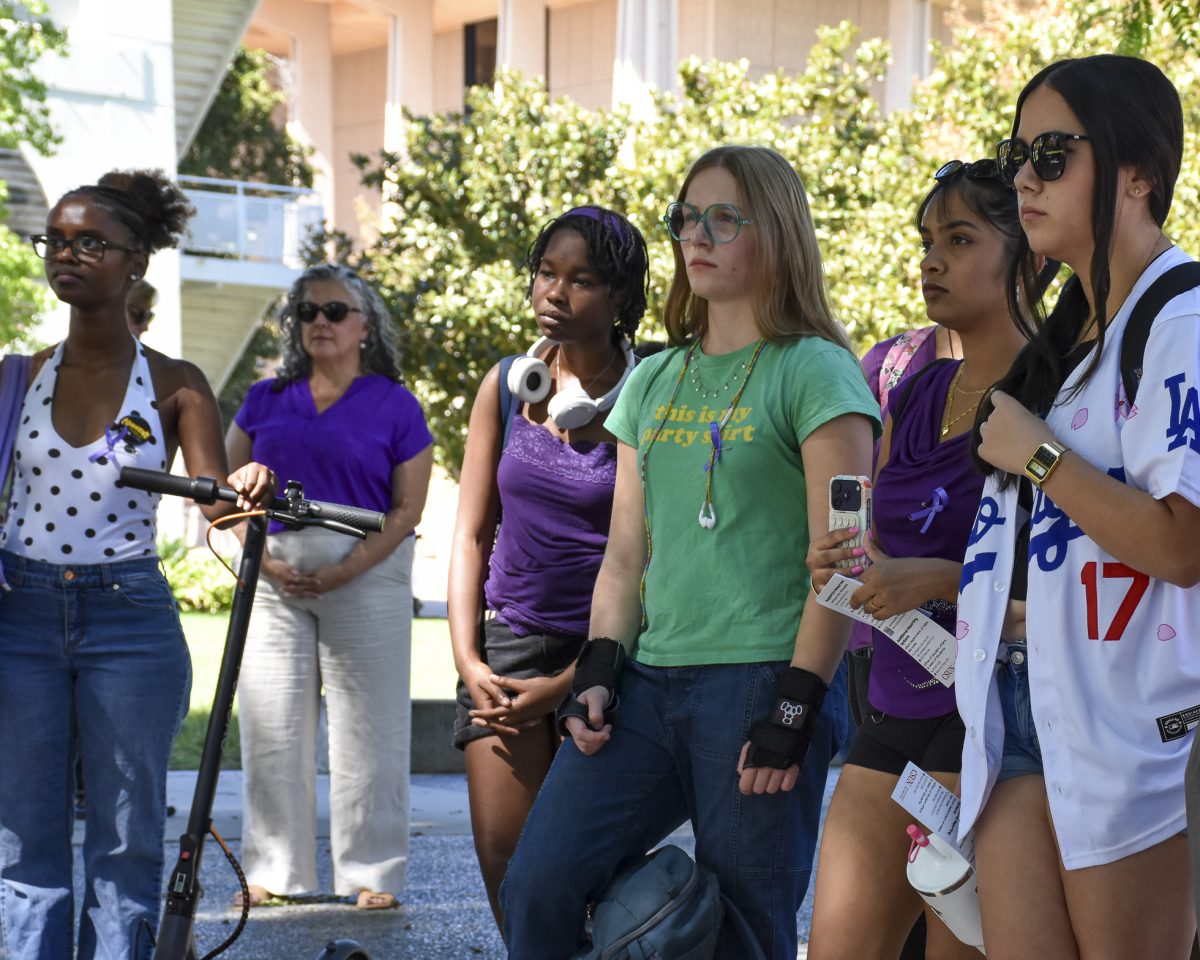
CSUN students and campus leaders walked from Maple Hall to Matador on Thursday, Oct. 8, to stand against sexual violence, support survivors and call for changes that last beyond a single demonstration.
The noon walkout participants wore purple in recognition of Domestic Violence Awareness Month. Organizers and speakers emphasized consent, accountability and the importance of keeping conversations going, even when sexual violence cases are no longer making headlines.
Nhyira Bawua, president of the Black Student Union, said the gathering aimed to unite the campus community without requiring survivors to share their experiences publicly.
Bawua said survivors helped plan the event, with organizers seeking to protect their privacy. Accountability should not depend on whether a story goes viral. She emphasized that no one is entitled to another person’s body.
Nevaeh Zuck, president of Planned Parenthood Generation Action at CSUN, said the walkout should lead to sustained engagement.
“I think the main message I want people to take away from today’s walkout is that this needs to be a continuous conversation,” Zuck said.
Zuck called for more programs and support groups, better promotion of resources and follow-up with students about campus safety. Surveys could help identify needed improvements, Zuck said.
She also urged greater investment in campus organizations students turn to for help, saying required training does not fully address attitudes that normalize sexual violence.
In a speech, Zuck urged attendees to continue discussing sexual violence beyond high-profile cases.
“These conversations can not only happen when a case goes viral,” Zuck said. “They cannot only happen when people are watching.”
Bawua and Zuck described plans for continued programming, education and resource-sharing. Students can contribute ideas, join participating organizations and follow their social media pages for upcoming activities.
The California State University Nondiscrimination Policy, presented with Project D.A.T.E. or Discovering Alternatives for Today’s Encounters, states that the policy covers discrimination, harassment, retaliation, sexual harassment, prohibited consentual relationships, sexual exploitation and Title IX issues such as sexual assault, dating and domestic violence and stalking.
All employees and students are covered by this policy. The policy protects participation in education and employment without discrimination, harassment or retaliation based on a protected status.
According to CSUN’s Office of Equity and Compliance, sexual violence can have psychological, emotional and physical effects on survivors. Those effects may include depression, post-traumatic stress disorder (PTSD), suicidal thoughts, numbness or a sense of loss of control. Some people may use drugs or alcohol to cope.
However, healing is possible with appropriate help and support. When responding to a survivor, make sure you believe them. Remind them they did nothing to deserve this and rape and sexual assault are never the victim’s fault.
“I hope that this walkout will accomplish more people being open to having these uncomfortable conversations about sexual assault,” Kori Higgins, a senior psychology major, said.
Higgins proposed discussions about sexual violence and coercion in University 100 class to help students demonstrate their understanding of topics covered in required training. Attending future events would be another way to continue supporting the community.
Samajai Henry, an Afrikana Studies major, emphasized the importance of men supporting survivors.
“I believe it’s important for us to show survivors they do have a shoulder to lean on,” Henry said.
Henry called for increased campus security and urged university leaders to acknowledge students’ advocacy. Students unable to attend could still support survivors and raise awareness individually, Henry said.
Suzannah Rogan, assistant director for prevention and education, expressed frustration with repeatedly needing marches, rallies and painful disclosures to prompt action.
Rogan urged attendees to support people who disclose violence, learn about resources and challenge harmful behavior among friends.
“We need you to come to events. We need you to learn. We need you to grow,” Rogan said.
Changing campus culture requires compassion and continued learning, including after mistakes, Rogan said.
“Stay vocal. Stay angry. But I need you to use that anger to do something,” Rogan said.
Julia Gulchin, president of the Panhellenic Council and a member of Alpha Xi Delta, rejected blaming clothing, makeup or intoxication for sexual violence. Gulchin placed responsibility on the person committing violence and emphasized listening to survivors regardless of how much time had passed.
Participants framed the walkout as a starting point. Their proposals differed, but a shared expectation was follow-through: sustained support, continued education and a campus conversation that does not disappear when public attention moves elsewhere.
To read this story in Spanish, click here.