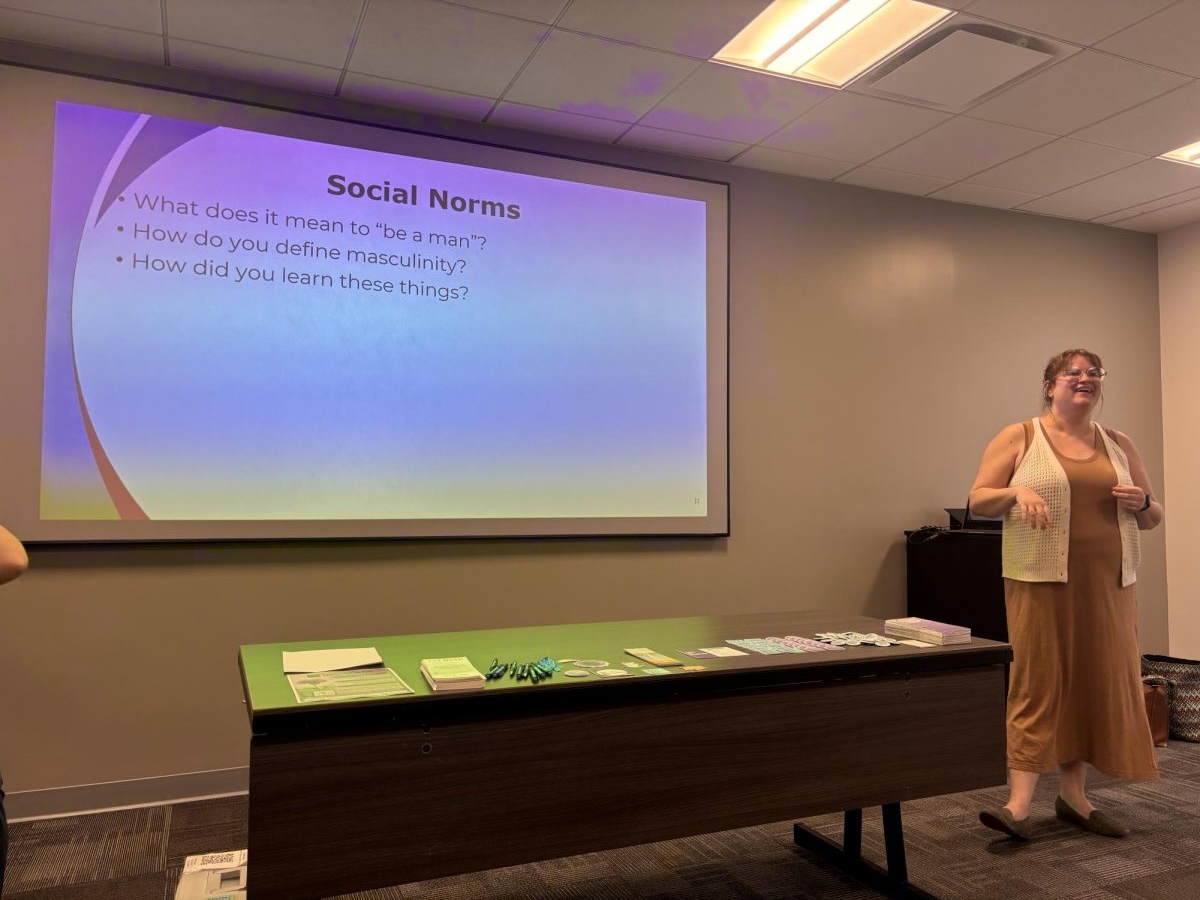
Students and faculty gathered in the East Conference Room for CSUN’s Project D.A.T.E. annual wellness event, “It’s On Us,” on Oct. 22 to confront a topic that impacts everyone: masculinity.
The session, titled “What is Masculinity and How Does It Affect Me?,” was led by Suzannah Rogan, assistant director for Prevention & Education. It invited attendees to examine social norms, power dynamics and personal values tied to gender.
Rogan, who holds a master of science in gender, media and culture with over a decade of experience in prevention education and more than 12 years in supervisory roles, opened the session by acknowledging the complexity of the topic.
“We’re gonna talk about social norms, particularly masculine social norms, and then we’ll talk a little bit about power and how that plays into that, as well as think of a new way of how we can talk about masculinity,” Rogan said.
The discussion focused on masculine social norms, the role of power in shaping them and explored new ways to talk about masculinity. The session was interactive and included audience input.
Rogan’s work involves handling CSU Nondiscrimination Policy concerns, connecting the campus community to resources, providing support and accommodations, creating educational programs and ensuring compliance with state and federal regulations.
Rogan’s journey into masculinity studies is deeply personal. Growing up in a household affected by domestic violence and experiencing the loss of her mother and nephew, she shared how the presentation was made in honor of her niece and nephew, as well as for herself.
“I have witnessed some of these things firsthand,” she said. “That is what drives me. I don’t want someone to grow up the same way that I did. That’s what’s so important to me in this work.”
The workshop included interactive exercises designed to make participants think critically about the values they hold and how society attaches gender expectations to them. Attendees paired up to discuss selected values, asking whether these values carried gendered assumptions.
“I am childfree by choice,” Rogan said. “So, if I say nurturing is a value of mine, would people automatically assume I’m a mother? Or do I apply that elsewhere? Are there gender expectations around specific values?”
Students discussed how social expectations often link hard work with masculinity, pointing out that society tends to picture men in physically demanding jobs when thinking of “hard-working” individuals. They noted that determination and effort take many forms and can be seen across all types of careers, regardless of gender.
Others reflected on how cultural norms discourage men from expressing vulnerability. They discussed the pressure many men face to suppress emotions or avoid seeking help, and how those expectations can have serious consequences for their mental health and well-being.
Rogan emphasized the structural aspects of gender norms.
“We love to categorize people in society as man or woman, and we always place one above the others,” she said. “It may not feel that way individually, but socioculturally, it does.”
Using examples from leadership, parenting and professional roles, Rogan highlighted phenomena like the “glass cliff,” where women are placed in high-risk leadership positions and then blamed for failure.
Rogan described three expressions of masculinity, emphasizing that these behaviors are learned and context-dependent rather than inherently good or bad.
Rigid masculinity occurs when someone conforms to societal norms without critically assessing them. According to Rogan, individuals in this category often follow expectations because they were told to, are rewarded for compliance and may enforce these norms on others.
Negotiated masculinity involves adapting to different social and cultural contexts for safety or acceptance, alternating between rigid and authentic behaviors, either consciously or subconsciously.
Emergent masculinity is rooted in authenticity and personal values, allowing individuals to express themselves in ways that align with who they truly are.
“A lot of spaces will say it’s great, men can have feelings now, but some of the same men will also say women are too emotional,” said Rogan. “We have to understand how they relate to each other, and we need all voices at the table to move these social norms forward. It’s about identifying those norms and changing expectations so everyone benefits, not just one group.”
She said gendered behaviors should not be ranked as inherently good or bad and highlighted the importance of inclusive dialogue.
“This is where we will get to a place where it’s not masculine good, masculine bad, feminine good, feminine bad, but rather, people good,” Rogan said. “These behaviors, these values make a good person. That is the space that I hope we can move into as we move forward.”