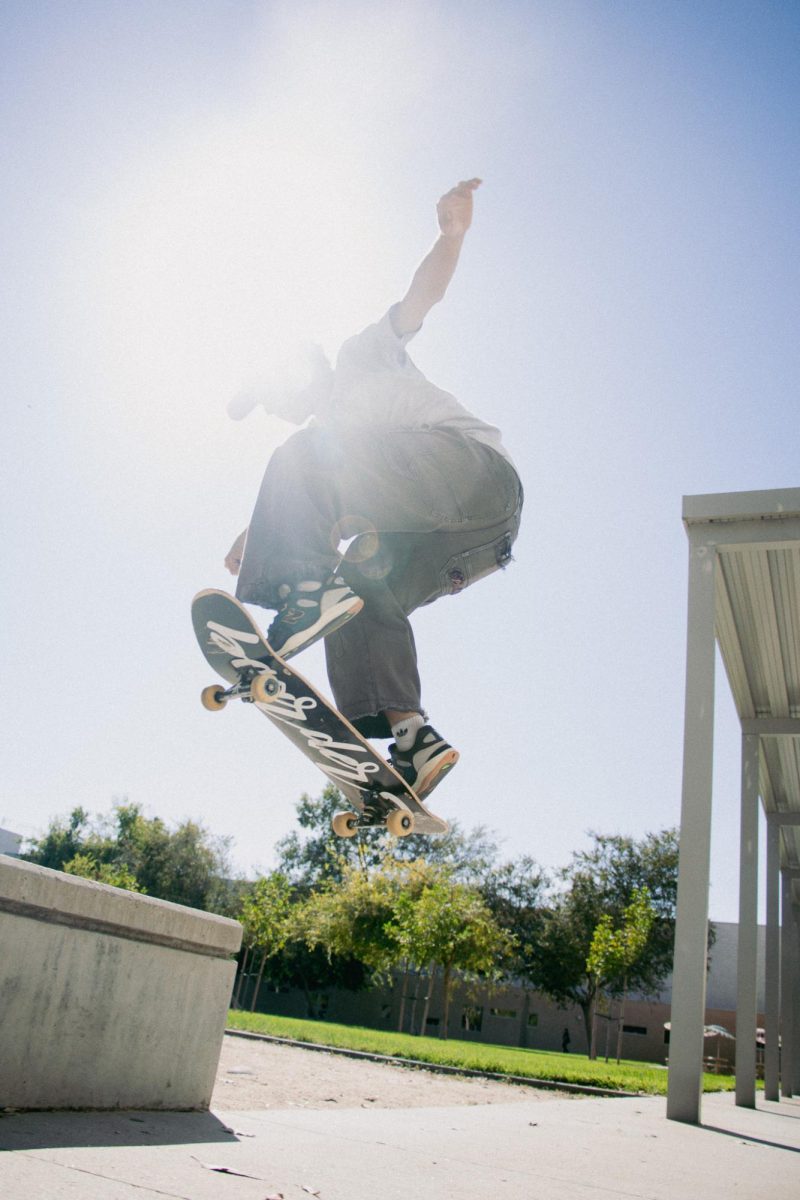
As the red curtain dropped on March 23 for CSUN’s rebranding of the former Maple Hall — now officially known as Ronni and Shepherd Goodman Hall — a student skateboarder was “forcibly tackled” to the ground in front of Manzanita Hall, just meters away, by the Department of Police Services (DPS) for skateboarding.
In a statement regarding the incident, DPS said that the officers answered a service call about three individuals trick skating at Manzanita Hall around 2 p.m. Nine minutes later, two CSUN police officers arrived at the hall’s north entrance and approached two unnamed student skaters.
The primary officer picked up the individual’s skateboard and told the student that trick skating is a violation of campus policy.
The individual had no ID, so he was required to go to the police station to receive a citation. As he began to comply and follow the officer, the report states that he “forcibly” grabbed his skateboard from the officer in an attempt to “take it away,” leading to both parties going to the ground.
DPS later said the individual “resisted arrest” and was booked at the LAPD Van Nuys Jail around 6 p.m.
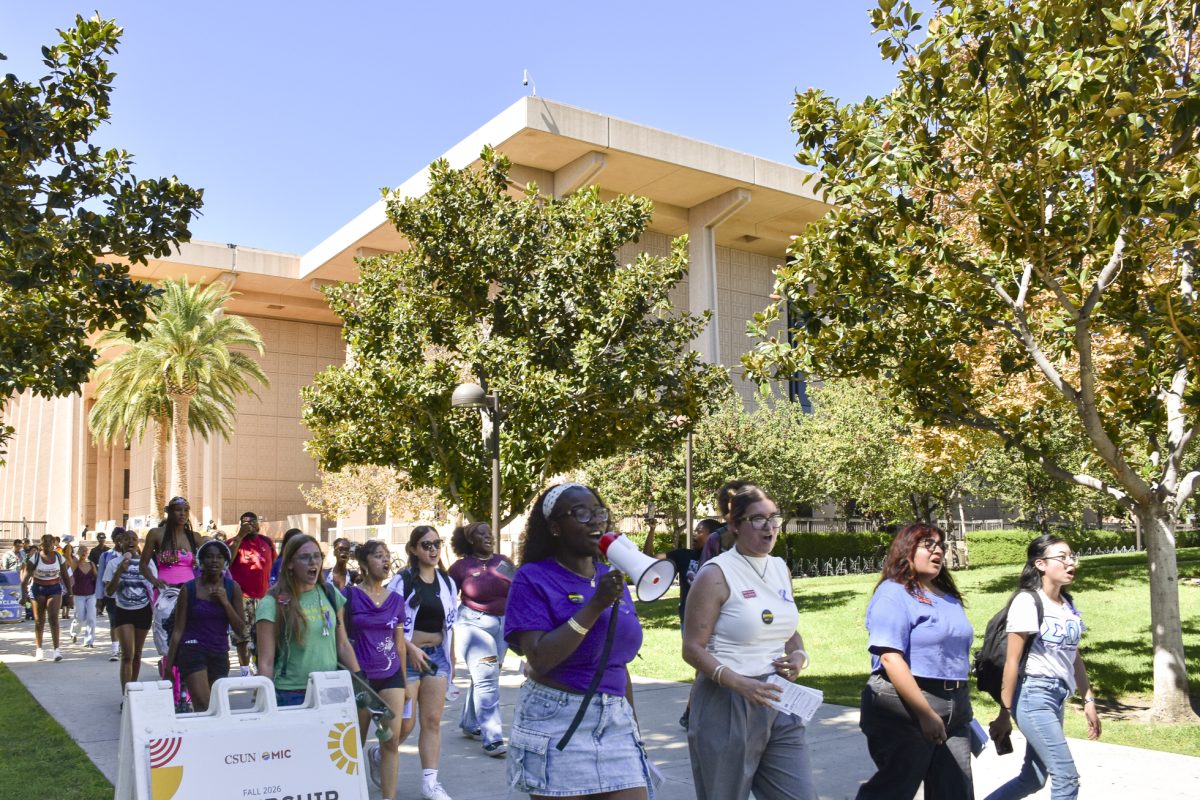
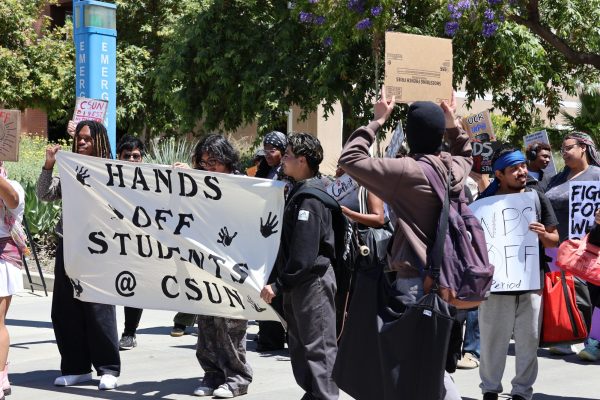
In response to this incident, along with several past student arrests, numerous campus social justice organizations, faculty and fellow student skaters have mobilized to create the Hands Off Students coalition, calling for the abolition of DPS in favor of a “community-based model of safety, care and accountability.”
The CSUN DPS is an accredited law enforcement agency recognized by the International Association of Campus Law Enforcement Administrators to ensure highly professional and protective services.
Recently, their professionalism and protective services have seemingly become a source of controversy for members of the coalition, stating they recognize a pattern of disproportionate use of violence against students of color.
Six officers, one skateboarder
CSUN Gender and Women’s Studies professor and Middle Eastern and Islamic Studies Director Khanum Shaikh reflected on the moment students came to her office asking for help after their friend was arrested.
A student sent her a video of the arrest, which the Hands Off Students Coalition described as “appalling.”
“They were like, ‘This kid got arrested violently,’” Shaikh said. “They sent us a video, so we saw … CSUN PD sort of throwing this young man to the ground and put a knee in his back.”
A student skater, who requested anonymity, said they witnessed two cops on top of the arrestee, one on his legs and the other on his neck.
“The cops grabbed his arm and then his board,” the student skater said. “He reacted afraid … you can tell by his face.”
From the moment Chicana and Chicano Studies Professor Martha Escobar first saw the video, she took issue with the way DPS handled the matter.
“From what I understand … he wasn’t skating at the time when the police took his skateboard from him,” Escobar said. “The student wanted to leave. He just went, ‘Okay, I’ll leave,’ and then the police escalated the situation.”
Delphia Williams, an acquisitions librarian at the CSUN University Library, is also the president of the Black Faculty and Staff Association, a member of the Black Student Success Council and an advisor for Students for Quality Education (SQE).
She learned about the student’s arrest from a colleague who received a video from a student witness and knew about her advocacy for students and over-policing.
According to Williams, because many skateboarders view their boards as important, skateboarders would not readily give them up, which she believes led to the confrontation and reported resistance to arrest.
The board was on the ground when DPS arrived at the scene, according to Manzanita student skaters. The police then asked who it belonged to, and the student said it was his.
“There was no need for cops to tackle him,” the student skater said, who described the incident as petty policing. “It’s so trivial, but they made it seem so threatening.”
Another student skater noted that after the arrest, three more squad cars had arrived, bringing the total to six police officers at the scene.
Policing on campus
Faculty and the Hands Off Students Coalition say this is the sixth known student arrest by DPS this academic year, with at least two students facing felony charges. All six arrested students are students of color, and three are Black.
“We’re a microcosm of what happens across the United States,” Williams said. “Over-policing of Black and Brown communities is not new. When the time-place-manner policy went into effect, policing seems to have escalated.”
Escobar has studied the criminalization of communities of color since her undergraduate days. She described the legal system as a structure of punishment rather than healing.
“We want to create positive change for students,” she said. “Instead of sending them to the criminal legal system, how can we better support them on campus?”
Escobar also questioned the department’s $2 million budget. CSUN’s approved 2025/26 operating budget totals at $566.6 million. According to the document, Police Services is allocated $2.7 million, while Counseling Services receives $2.75 million. Basic Needs — which addresses student food and housing insecurity — only receives $444,650 of the more than half a billion dollar budget.
“Budgets are moral documents,” she said. “Where we spend, that’s what we value.”
Williams said that the terms under which the student was arrested could have been handled differently.
She also referred to the DPS daily police log. That day, DPS listed the incident as resisting a police officer and an education code violation.
“Now, if it was an education code violation, that means it could be something handled on campus, but the moment you add resisting a police officer, it becomes something very different,” Williams said. “And unfortunately, the majority of the six students that have been arrested, one of their charges has been resisting a police officer.”
She said this signals to students that they’re being surveilled, that they’re being treated as criminals and not college students. Escobar sees a broader concern of how incidents involving students are being handled.
“Policing feels like common sense to many people; it’s so normalized that it’s hard to imagine alternatives,” she said. “There’s also an assumption that if someone is arrested, they must have done something wrong.”
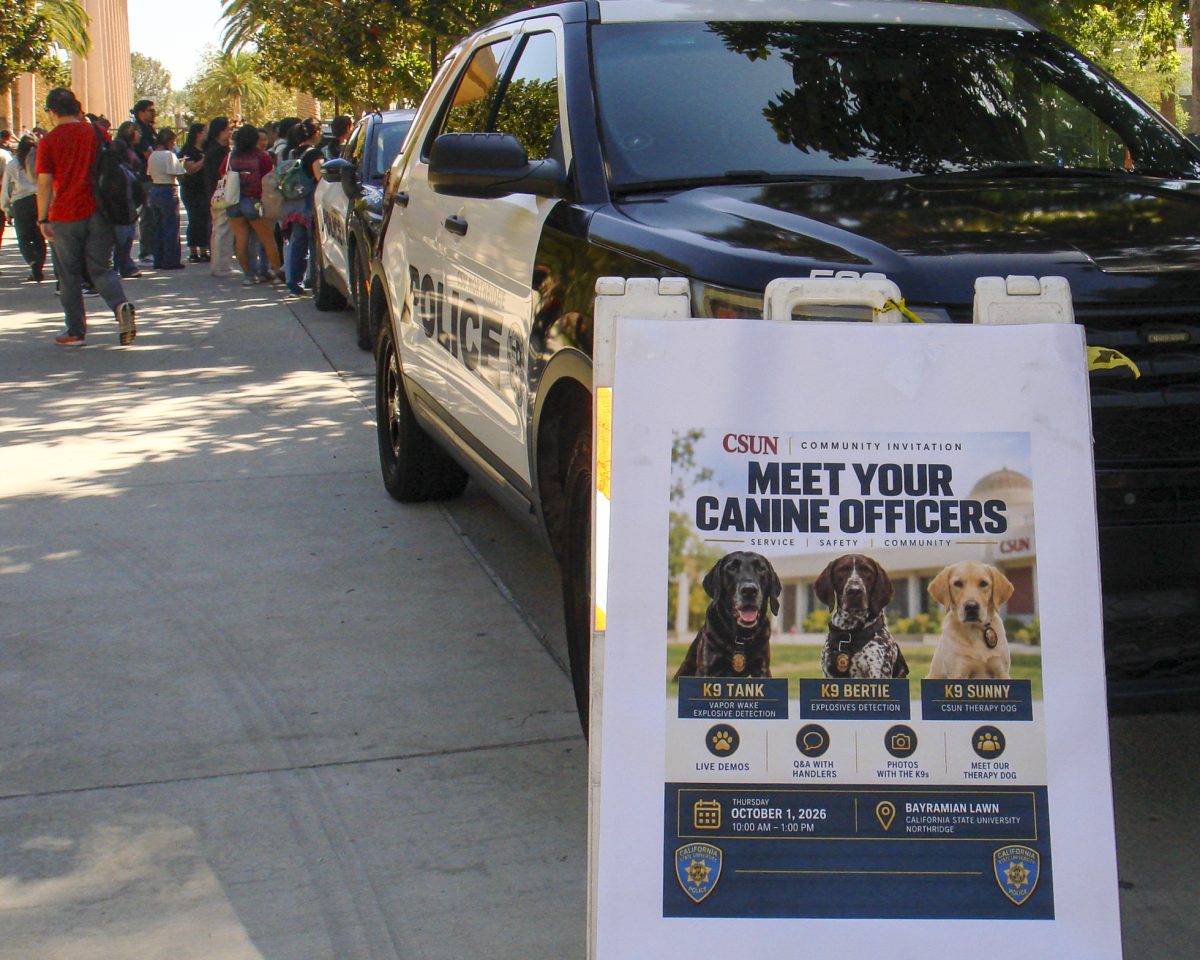
Escobar, Shaikh and Williams noted that there has been an increase in police vehicles around campus, and DPS is trying to normalize its presence, leading to a desensitization to police actions.
‘Degrees, not felonies’
President Beck has agreed to meet with the coalition soon, but for members like Shaikh, expectations are low, as issues at the administrative level can get sidetracked.
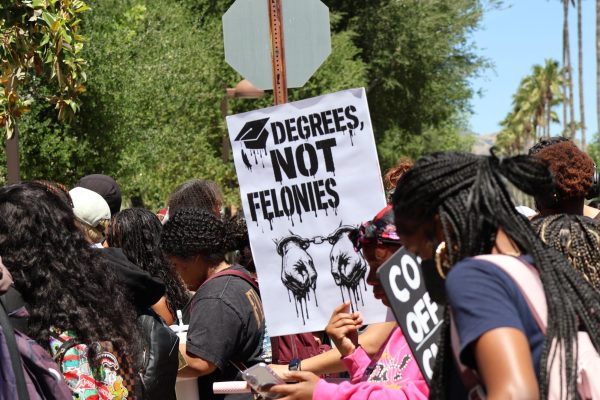
Along with the Hands Off Students coalition, the California Faculty Association has also relayed the message for CSUN to align its values and meet the coalition’s demands to eliminate anti-Black and anti-student policing.
“CSUN cannot continue to claim a commitment to Black student success while enabling systems that harm, criminalize and endanger those very students,” the coalition wrote in the open letter to Beck. “The current conditions are untenable. The time for rhetoric has passed. We demand action.”
According to Shaikh, students being charged has brought devastation, financial and emotional expenses to their families and an irreversible impact on the students’ future careers.
Williams, like Shaikh, also described the emotional toll of seeing students enter the criminal-legal system.
“I don’t want to see more Black and Brown students in jail, in the court systems trying to figure out how to pay bail,” she said. “I don’t want to sit with crying parents as they wait for their students to be released from jail.”
The caller who reported the skaters to DPS remains unknown. The Sundial requested the names of officers involved in the student arrest, however, DPS refused to offer that information.