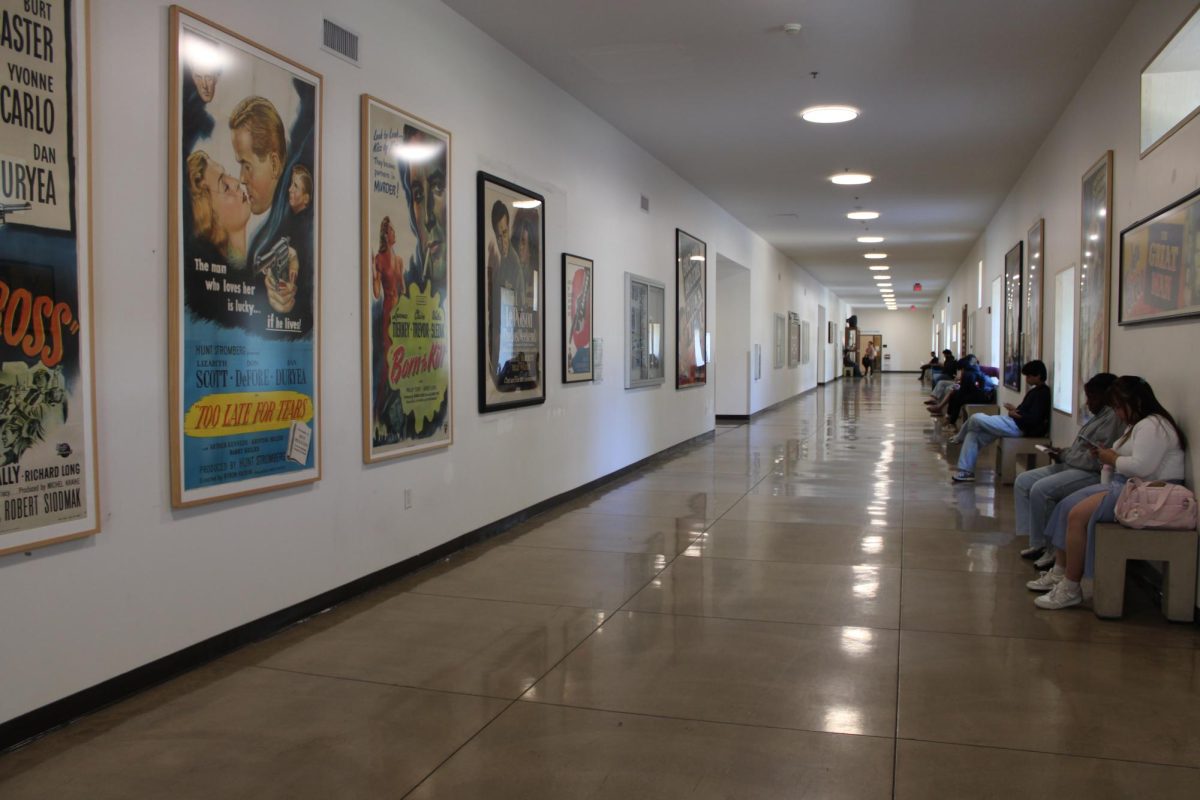
In February, CSUN students arrived in Manzanita Hall to find the floors covered with fliers calling to “Stop the Film Ego and B.S.”
The creators of @hope_for_csun, who chose to go by “Veteran” and “Dreamer,” created the group to make a space for isolated students within the Department of Cinema and Television Arts (CTVA). They aimed to create a space where students could share their testimony on any issues they have faced within the department.
“In this day and age, like, it’s hard to get people to voice [grievances], even if there are a bunch of resources and safety nets around them,” “Veteran” said. “That’s what hopefully this club – or ragtag team as we call it – like, hopefully ignites people to start voicing out because that’s the only way changes are going to be made.”
“Veteran” worked in the CSUN equipment room for a year and heard several stories of students experiencing “negligence, discrimination and isolation” by faculty members. According to him, multiple students were also discriminated against, including himself.
“I’ve noticed that in the equipment room, like, students getting discouraged or they’re feeling unwanted or neglected,” “Veteran” said. “And my issue is like morality, actually. Like, if more morals are low, like people aren’t going to do stuff, and I’ve been seeing that almost every semester since I’ve been in the film program.”
“Veteran” said he is “not surprised” by the discrimination within the film department.
“In this type of industry, it is very easy to form favoritism cliques. And like, well, if you’re not fitting the standard, you get pushed aside,” he said.
Shortly after they took their first step with the flyers, tossing them throughout Manzanita Hall, “Veteran” was sent a cease-and-desist after the faculty cleaned up. The faculty organized a meeting with both “Veteran” and “Dreamer”, but they refused to attend. Eventually, they were told to “go to the people,” because that’s “the root of all the problems.”
Angel Perez, a documentary major, first connected with the movement through the fliers. Knowing his story was what they wanted, he reached out to give his testimony.
His main source of frustration was not feeling able to work to his full potential in certain classes due to pushback from professors. He said he was called “challenging,” was constantly shut down by professors and was limited to using only certain editing software despite his level of experience with other programs. Soon after the class started, he stopped participating.
Luckily for Perez, he was not the only one. He and several other students would come together to talk about these issues. According to Perez, they all quickly stopped asking questions in class for fear of being berated rather than helped.
“Why should we put in that much money and strain on ourselves just to be treated like sh– and like we don’t know anything?” Perez said.
Johnson Monroe, who requested to go by an alias out of fear of retaliation from the department, is a CTVA production program student who said he has witnessed firsthand favoritism from faculty.
“The scripts that were chosen personally to me, two of them, I’m very questioning of how they got chosen,” Monroe said.
According to Monroe, who did not pitch a thesis himself, the students whose films were selected by the committee are known to be well-liked by faculty, allegedly having “leverage” over other students. He also explained that while he knows a committee is behind the selection process, students are not party to who sits on that committee.
This revelation came, Monroe said, after facing other “mismanagement” issues from the department, along with witnessing what he called a general lack of disrespect towards students – including a lack of transparency from faculty.
“I was originally supposed to have a key position in one of the thesis projects,” Monroe said, explaining two fellow classmates placed him on their film proposals. One of those students, whose thesis was ultimately selected, removed Monroe from the role after being misinformed that Monroe could only be placed on one proposal.
This led to Monroe being placed in an assistant role, which ranked lower than his previous role, and stripped him of leadership experience.
Throughout his time in the program, Monroe said he does not believe he earned skills at CSUN that he can take into the professional world.
“If I make it in this industry, I’m not acknowledging CSUN for anything,” Monroe said. “I’m going to bluntly state I earned my skills and I earned my reputation through my community college and my high school.”
A student who requested to go by her first initial, A, watched drama unfold within the CTVA program as an outsider looking in. When A first applied to CSUN, she intended to attend as a CTVA production major, but was quickly discouraged.
While taking a fundamentals of film production class, A said she witnessed favoritism between teachers’ assistants in the program and heard rumors from others in the major about how exclusive the program was.
“It really shied me away from even applying to the program, from even trying,” A said.
Now, A studies entertainment media management and still dreams of working in production, but is facing challenges. A said it is difficult to make connections in the film world without help from the department.
“It’s forcing me to work harder, which I don’t mind,” A said. “It just kind of sucks that, like, I wanted to come to the school for the program … It’s just like it feels like it was all a waste of my time and effort.”
Though the hall was littered with flyers calling for “Stop Nate Thomas,” Thomas’ office is littered with highlights from his time at CSUN.
“I got a lot of thank you notes … lots of awards,” he told The Sundial, highlighting the Wang Family Excellence award hanging on his wall. “That doesn’t mean that I’m great, means that I’m doing something right.”
This was a personal attack, Thomas felt, and he was initially shocked when he saw the flyers. While he is the “face” of the department, Thomas explained that direct decisions surrounding senior film proposals are made by a committee – not by himself.
Regarding the alleged lack of transparency in selecting proposals, Thomas admitted that the rubric used will not be shared with students. However, he elaborated that the committee chooses films that are not only “the best” but also “doable” with the tight budget that students are expected to raise themselves, running from about $30,000 to $45,000.
Only four film proposals are selected each semester from a pool of approximately 30 proposals.
“I get it, I went to film school at USC, grad school, the number one film school in the world,” Thomas said. “People are upset when they don’t get shows, and they always say the same thing at USC – it’s favoritism.”
Here at CSUN, Thomas believes there may be another underlying motive in attacks against him, whether the accusers realize it or not. Thomas, explaining he has raised thousands for the program, building it up to be one of the top in the country, said he is a target because he is a Black man in power.
“I think it’s a racial issue, too, because I was the only one listed on that flyer, and I’m a
Black man, and I have issues with that,” Thomas said.
As Hope for CSUN has stated on their Instagram, Thomas is threatening to sue for defamation, though he has yet to do so. According to him, the students’ statements that name him directly do not fall under the right to freedom of speech, according to California Civil Code 43 and 44.
The code states a person has the right to be protected against defamation, which includes libel and slander. Libel is characterized as “false and unprivileged publication,” causing one to be “shunned or avoided.” To prove defamation in court, Thomas would need to prove that the statements are false. However, the California court case of Copp v. Paxton (1996) determined that “opinions are not actionable as a matter of constitutional law.”
Megan DeFrancesca, a student majoring in narrative television production, believes the television department’s thesis selection system is fairer than the film production program. For television majors, the selection process falls on their fellow students, not on the staff. Every semester, the theses are presented to the class and are voted on.
According to her, it leads to more participation, as the project was chosen as a group, and gives the students real-world experience with pitching.
“This semester, no two projects are the same,” she said. “It’s a pretty wide variety because each of the pitches are made not with the idea of appeasing one specific person. One person thinking that you’re driven or not driven shouldn’t determine whether or not you get a chance to prove that fact.”
Even when she was not chosen in previous semesters, DeFrancesca would use the feedback from her peers and professors to further develop her pitch to present the following semester.
Seeing the flyers against Thomas was no surprise, as she and several others had heard rumors about the department and staff.
“I know that the TV department prioritizes essentially giving students as many chances as possible to work on a bunch of different projects,” DeFrancesca said. “Essentially, use the college environment as a place to learn and grow. I feel like you can’t really do that if the program is keeping you in a contained box where you can only do what a professor is specifically telling you to do.”
For Thomas, students who take issue with the department are often the “sour grapes.” He denies favoritism, but said he notices the students who show up and do the work.
Thomas advises students with concerns about the program to set up a meeting with either him or Department Chair of Cinema and Television Arts Jared Rappaport, saying they encourage feedback from students.
“I came here to do a job, teach and inspire students, and that’s what I do,” Thomas said. “And so if there are a few people, get real. That’s how Hollywood works. We can be better at it, but they also need to learn.”