
Nov. 5
5:30 p.m., 77% of votes counted, Jaya Roberts
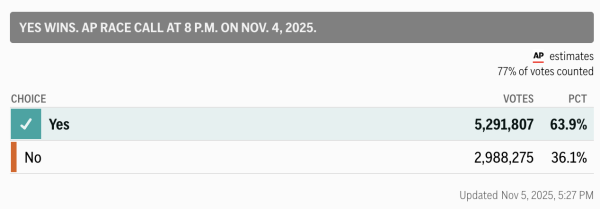
As of 5:27 p.m., 77% or 8,280,082 votes, had been counted, according to the Associated Press. 63.9% of voters supported Proposition 50, while 36.1% of voters opposed the measure.
Nov. 4
11 p.m., Final Day to Decide: Voters Turn Out for Proposition 50, Samantha Kline
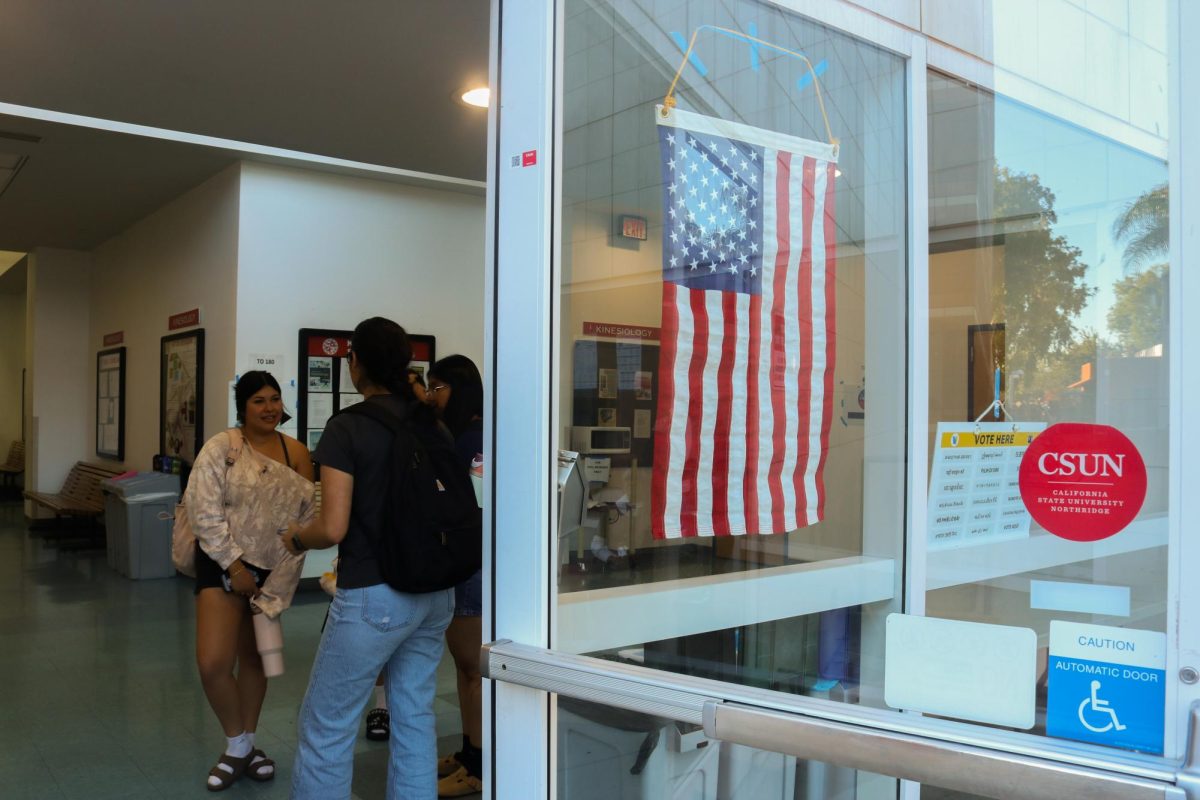
It’s the final day for voters to weigh in on Proposition 50; a measure that will reshape California’s congressional districts starting in 2026. At CSUN’s Redwood Hall, long lines formed as residents cast their ballots and shared why this vote matters to them. From calls for fairness to reminders about local impact, Angelenos say every voice counts in shaping the state’s political future.
10:30 p.m., Over half of votes are counted, Taylor Parise
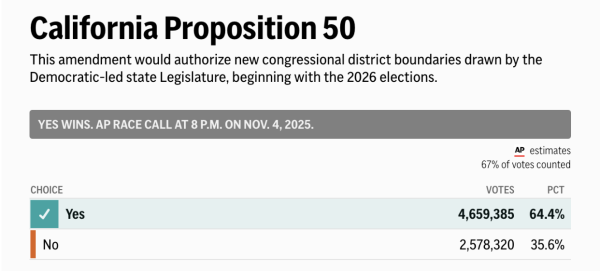
Two and a half hours following the closure of polls across California, 67% of votes have been counted, according to the Associated Press. 64.4% of Californians have demanded mid-decade redistricting, while 35.6% resisted Newsom’s proposition.
8:15 p.m., Voters drawn to the polls minutes before closing time, Aly Hawkins
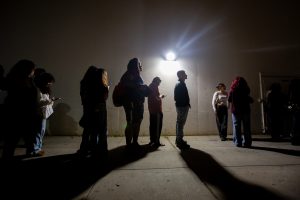
Several voters cited work and academic obligations as reasons for casting their ballots late, yet many expressed that it was important for them to make their voices heard.
Christine Avalos stood in line with her mother and 12-year-old niece, proud to be “teaching” the younger family member about the democratic process. She underscored the importance of her own family members fighting for the right to vote and said she votes in every election to honor that fight.
Avalos, along with her mother Angie, is Republican and chose to vote “no” on Proposition 50. According to her, the Avalos family, who identify as Hispanic, vote Republican because their ancestors worked hard to enter the U.S. and believe all Americans deserve equal benefits, rather than one demographic.
“Not to put down other people, because we know what that struggle is,” Avalos said, “but it shouldn’t be just handing out things for people.”
Gerardo Simental, a CSUN junior studying liberal studies, felt a sense of accomplishment as he was one of the last voters to cast a ballot. Simental voted “yes” on Prop 50 because he felt it was a way to speak against actions within the Trump administration he does not agree with.
“I knew I had to do this and use my voice,” Simental said. “Supposedly there’s already checks and balances in our government, but it doesn’t feel like it.”
The last voter of the day, Gabriel Torres, felt so inclined to vote that he ran with wet hair to the poll center. Torres, who plans to pursue a career in politics, turned 18 in October and was excited to vote in his first election, but initially thought he had missed his opportunity to do so.
Upon exiting an evening shower, Torres received a call from a friend informing him about same-day registration. He ran from his dorm room to Redwood Hall, getting in line at 8:05.
“As a first-generation Latino, I’ve been inspired by recent events to become politically involved,” Torres, who voted “yes” on Proposition 50, said. “I believe our country is in a very uncomfortable place for a lot of people, but I do believe that things will become better for everyone in the future.”
Volunteers at the polls shared that the unofficial tally of voters that checked in for the day was 2,085. The group will be there approximately an hour and a half after the polls close to tally the ballots. While many urged voters to vote earlier in the next election, noting that the center was open for ten days prior to Election Day, others expressed their general appreciation that people took part in the process at all.
8:02 p.m., “Yes” wins, according to Associated Press, Taylor Parise
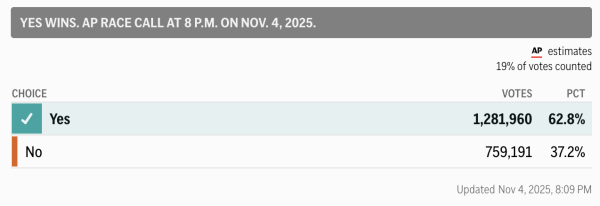
With only 2% of votes counted, the Associated Press Decision Desk called the special election in California. As of 8:09 p.m., 1,281,960 votes counted were “yes” for Proposition 50, and 759,191 Californians voted “no.”
Currently, 62.8% of Californians approved the proposal for California’s redistricting.
7 p.m., Voting red in a blue state, Taylor Parise
Aurora Coulombe, a senior psychology and religious studies major at CSUN, drove an hour and a half to San Bernardino county to vote. Coulombe said she enjoys voting in her home county, giving her an opportunity to visit her family.
After discussions with those around her, including friends in CSUN’s Turning Point USA chapter where she serves as social media manager, Coulombe decided to vote “no” on Proposition 50. She sees the proposition as a fight between Gov. Gavin Newsom and Texas Gov. Greg Abbott.
“We shouldn’t vote for something because a state is upset at another state,” Coulombe said. “We should be voting for something that is actually important and matters, not because the higher up officials are fighting.”
Within her family unit, Coulombe said members each voted differently, with her step father planning to vote “yes.” She also pointed out that a friend in Turning Point plans to vote “yes” on Proposition 50 while another voted “no,” highlighting the diverse viewpoints in the group.
Coulombe predicted Proposition 50 will likely pass, but she refuses to let voting red in a blue state discourage her.
“Personally, it’s just the fact that, like, you did your best to make a difference,” Coulombe said.
6 p.m., Campus voting line reaches over 300 people
Danielle De Leon, Taylor Parise, Jaya Roberts
All volunteers at the campus vote center arrived at 6 a.m. and expect to stay until approximately 11 p.m. Volunteers reported having one campus voter who became a citizen today.
As of 6 p.m., an estimated 300 people were standing in line waiting to cast their ballots. According to the lead volunteer on-site, the vote center has checked in 2,700 voters, averaging 246 votes per hour.
Volunteers estimate that the center will receive 4,000 votes by the time the final ballot is cast.
As long as voters get in line by 8 p.m., they will be able to cast their votes.
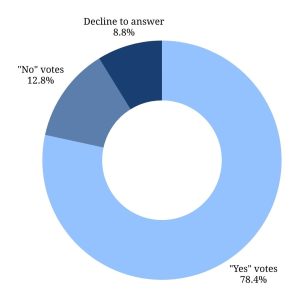
The Sundial polled 125 voters in line outside of Redwood Hall. Of those voters, 98 reported they were voting “yes” on Proposition 50, with 16 reporting they would vote “no.” 11 people declined to answer.
4:30 p.m., 2,000 voters checked in at CSUN, Danielle De Leon
As of approximately 4:30 p.m., the CSUN vote center checked in nearly 2,000 voters, doubling the amount of votes recorded on campus in the span of one hour, according to the lead volunteer on-site.
At this time, polls have been open for nine and a half hours, averaging 211 voters per hour, surpassing volunteer Jayne Haggart’s estimate from 2 p.m. A massive line has formed, curving around the building with an estimated 210 people waiting to vote.
2:30 p.m., Out-of-district voters, Jaya Roberts
According to volunteers on-site, those registered outside of Los Angeles county can vote at the campus vote center.
When checking in, voters must tell the volunteer helping them that they are registered in a different county, and which county they are registered in.
Voters must then decide whether they would like to remain registered in their current county, or change to Los Angeles county. They will then be able to proceed and cast their vote.
2 p.m., 834 voters checked in at CSUN, Jaya Roberts
As of just before 2 p.m., the CSUN vote center had checked in 834 voters, according to volunteer Jayne Haggart.
Polls have been open for seven hours, meaning that the CSUN vote center has checked in an average of 120 voters per hour. Haggart estimated that if the pace continues as it has been so far, the CSUN vote center could welcome close to 1,560 voters on Election Day.
1 p.m., Counted advance ballots, Jaya Roberts
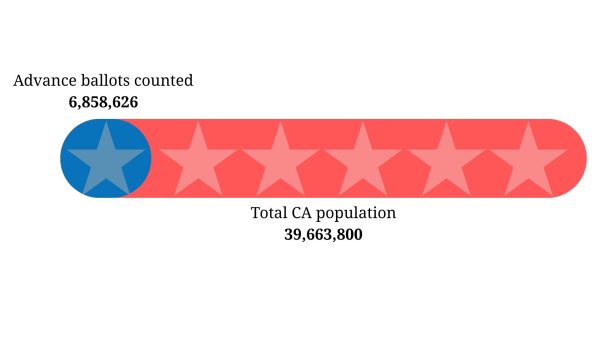
More than 6,800,000 advance ballots have been counted prior to Election Day, as reported by PBS. This amounts to around 17.2% of the total California population as estimated in 2024. The figure includes ballots from early voting and mail-in ballots.
11:20 a.m., Conditional voter registration available, Taylor Parise
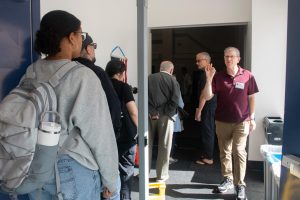
A line of more than 20 voters stretched outside of CSUN’s voting center. Tom N., a volunteer, directed students towards the registration and drop off tables inside Redwood Hall.
One student approached Tom with the hopes of voting on campus despite being a Ventura resident.
According to the Los Angeles County Registrar-Recorder and County Clerk’s office, students may vote outside of their county through a Conditional Voter Registration. Though this is discouraged, it is an option for students unable to make it back to their county in time to vote.
“What if they don’t vote because they think they can’t?” Tom said. “That’s the worst thing, right?”
Tom has been volunteering at election centers since 2006 – or as he called it, he was “volun-told” by his wife. Tom fondly recalled working at centers located in community member’s garages and local churches before the times of electronic voting machines.
Student Ashley Villa made sure to fit in time to vote because her mom is unable to.
“I kind of just feel like I owe it not only to her, but to all other people that are kind of going through it right now,” she said.
She said other students may feel their vote does not matter, but believes it is important to stay informed and understand that students can make an impact in their local government
8:15 a.m.,Volunteers lead the room in applause, Taylor Parise
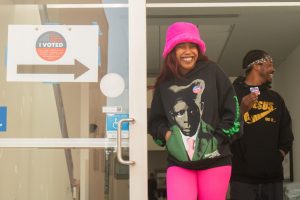
Social worker Walid Javis entered the election center with the goal of being a more active participant of democracy.
“It’s where I’m at in my life,” Javis said. “I’m more hypervigilant. I’m sensitive to what’s going on, and my friends and family are encouraging me … to learn about what’s going on.”
Javis works for Special Services for Groups (SSG), a nonprofit health and social services organization, providing services for those experiencing mental health challenges, substance abuse issues, the recently incarcerated and those experiencing homelessness.
His work connects him closely to the Los Angeles community and inspires him to make a difference in any way he can. Most recently, the loss of SNAP benefits shocked Javis, and he believes it is his duty to speak out against actions impacting his community – leading to a “yes” vote on today’s proposition.
Only his second time voting in his recent memory, Javis said poll workers were supportive, with one making a joke that he was “growing up.” This led Javis to being applauded on his way out of the center.
“It felt kind of good to be recognized by people you don’t really know,” he said. “They’re happy for you because they sense that I’m happy.”
Voting alongside Javis was CSUN senior Ashton French, who has been voting in every election she was able to since the day she turned 18. She said having a voice matters, especially during the Trump administration.
French also hit the “yes” button when voting in one of Redwood Hall’s yellow booths.
“We need guardrails,” French said. “Someone has to do something, someone has to say something, there has to be some adults in the room.”
7:10 a.m., First student voter of the day, Taylor Parise
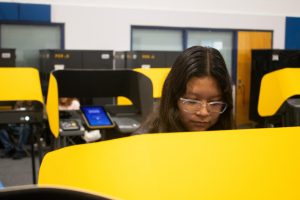
Mia Ramos walked into room 180 of Redwood Hall, unsure if she would be able to vote on Election Day. Newly 18, her mom encouraged her to go to CSUN’s campus election center and exercise her right to engage in democracy.
Ramos, a freshman psychology major at CSUN, entered the poll room 10 minutes after the doors opened to the public. She gave a volunteer her name and registered to vote in her first election – the special election for Proposition 50.
“I voted ‘yes,’” Ramos said. “I think that saying yes is going to help push the government to open up and then stop Trump from doing stuff that he’s not supposed to be doing.”
As the daughter of an immigrant, Ramos feels a responsibility to represent not only herself but also her community and those who are unable to vote.
The room of volunteers broke into applause as Ramos submitted her vote. She exited the center with a smile on her face and her “I Voted” sticker in hand.
7 a.m., Election Day begins, Jaya Roberts
Polls state-wide, including the CSUN vote center located in Redwood Hall, Room 180, will open at 7 a.m. and remain open until 8 p.m. Follow along as the Sundial produces live Election Day coverage on and around campus.
Oct. 30
Prop. 50 raises broader questions about ethics and power, Taylor Parise
Alexandra Macias, a political science professor at CSUN, has long upheld the California Citizens Redistricting Commission (CRC) when lecturing in her classes. The commission, whose creation was authorized in 2008, was established to ensure fairness and bipartisanship in California districting.
For Macias, this commission has served as a model of good government for the rest of the country. However, despite it being highly regarded nationally and winning the Harvard Innovation in Government Award in 2017, residents of the Golden State are now being asked to vote to temporarily dismantle the group’s work with Proposition 50.
Oct. 24
Know before you vote, Sara Wolf
Governor Gavin Newsom and President Donald Trump engage in a tug of war over the number of U.S. House seats.
California voters can expect a special election on Nov. 4, where they will vote on Proposition 50.