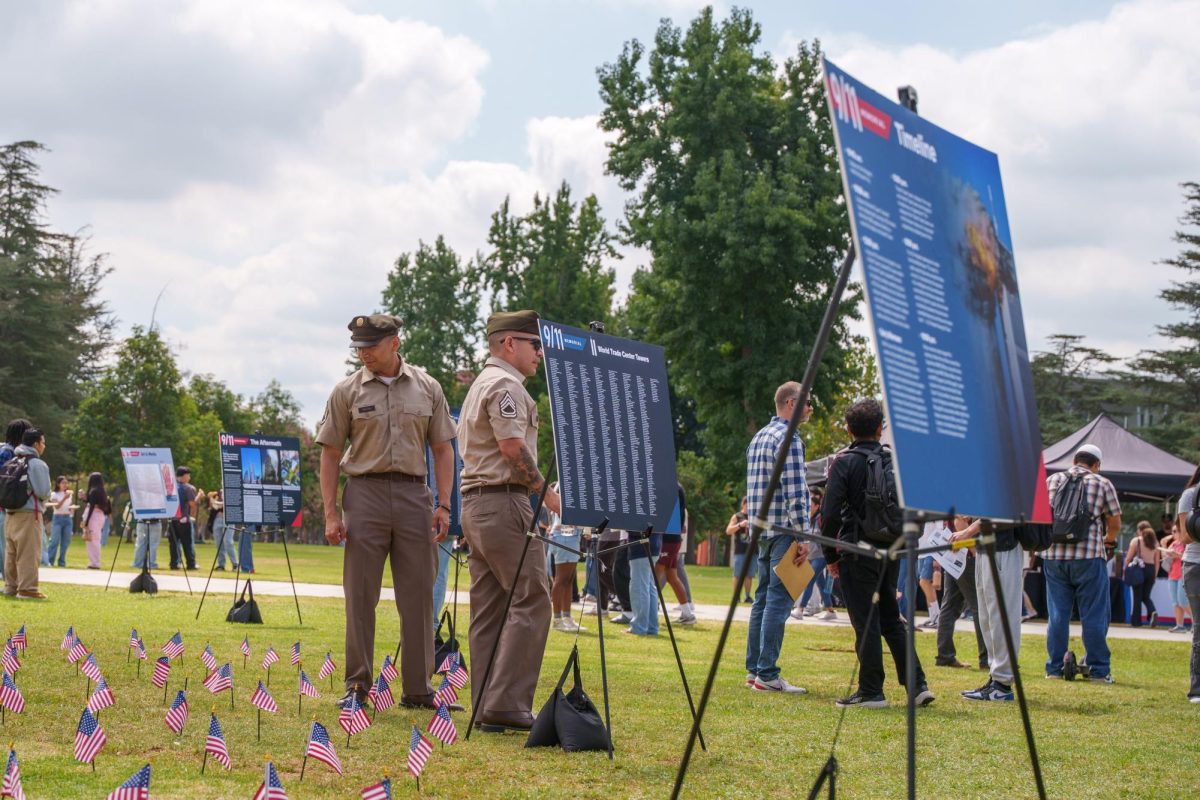
CSUN’s Veteran Resource Center (VRC) hosted its annual 9/11 memorial event on the University Library Lawn Sept. 11 from 11 a.m. to 2 p.m. Miniature American flags covered the grass, each one representing 10 people who died during the attacks on Sept. 11, 2001.
Reserve Officer Training Corps (ROTC) cadets lined up in uniform around the perimeter, guarding the display.
As attendees entered the event, they were greeted with an interactive poll asking them to write one word describing 9/11’s significance. Responses included “depressing,” “horrific,” “care,” “interesting,” “scary” and “tragic.”
Many of the VRC workers who contributed to the event were veterans themselves, some old enough to remember the attacks.
“I remember the aftermath of it and how I didn’t fully understand it, but the adults around me were very shaken by it,” Casey Gomes, Navy veteran and VRC events assistant, said. “The reason a lot of us ended up enlisting was because of 9/11. A lot of reservists got activated, so a lot of our members being deployed and going off is directly the consequence of 9/11.”
ROTC cadets, many of whom were not old enough to have experienced or remembered 9/11, volunteered to help in the event. They said they still feel connected now that they are in the program.
“I’m an empathetic person, and I know what it’s like to lose family members,” said Vanessa Guerra, a freshman ROTC cadet. “Now I get to serve my country and community in my own way so that hopefully it doesn’t happen again.”
According to Gomes, the event’s main goal was to both honor the victims and educate CSUN students about the tragedy, since many were either too young to remember or had yet been born. Boards placed throughout the Library Lawn displayed a timeline of events from 9/11, victims’ names and the aftermath, including art and media inspired by the attacks.

“The average typical college student is so far out from 9/11 itself that it’s hard to connect that tragic day to the current student,” said Marine veteran and VRC Manager Robert Graves. “We wanted to just pay homage to the Americans who ended up losing their lives.”
At the bottom of the University Library stairs, a display featuring a round table adorned with a white tablecloth and a black folded chair reading, “You Are Not Forgotten,” was dedicated to the memory of all service members. The chair symbolized fallen or missing service members, while the round table and white tablecloth represented “our concern for them is never ending,” the purity of service members’ response “to our country’s call to arms.”
Additionally, a black napkin on the table stood for the “emptiness that they had left in the hearts of their loved ones,” accompanied by a Purple Heart medal, a single red rose, a yellow candle with a yellow ribbon, a slice of lemon and a wine glass turned upside down.
Attendees were welcome to walk through the exhibit, which led to a booth with ROTC cadets handing out red tickets. Students were able to exchange the tickets for a free slice of pizza.
Students crowded the memorial, walking silently along the exhibit. International student Vidhi Khurana was not aware that the memorial was happening that day, but decided to take the time to learn about the tragedy and pay her respects.
“The mini flags are so precise and beautiful to look at,” Khurana said. “It’s sad; it shouldn’t have happened. It’s a huge trauma.”
Graves emphasized that organizers wanted to keep the memorial respectful and were prepared to allow space for any negative reactions without letting them undermine its significance. In the end, students responded positively.
“I was already in the Marine Corps when 9/11 happened,” Graves said. “I enlisted in a time of peace and then found myself in a time of war. That was not a choice of mine. These individuals that we’re memorializing, it was not a choice of theirs to be victims. So whether or not somebody has foul words or malintent, it doesn’t take away that people lost their lives.”
Graves had been serving in the Marine Corps for exactly one year at the time of the attack. The memory remains clear to him, remembering it as “shock and awe.”
“You can see the pain of 9/11 by watching the videos of 9/11,” Graves said. “But 9/12, that’s something you can’t explain. There was an energy of a united front that I don’t think we’ll ever get back to.”