
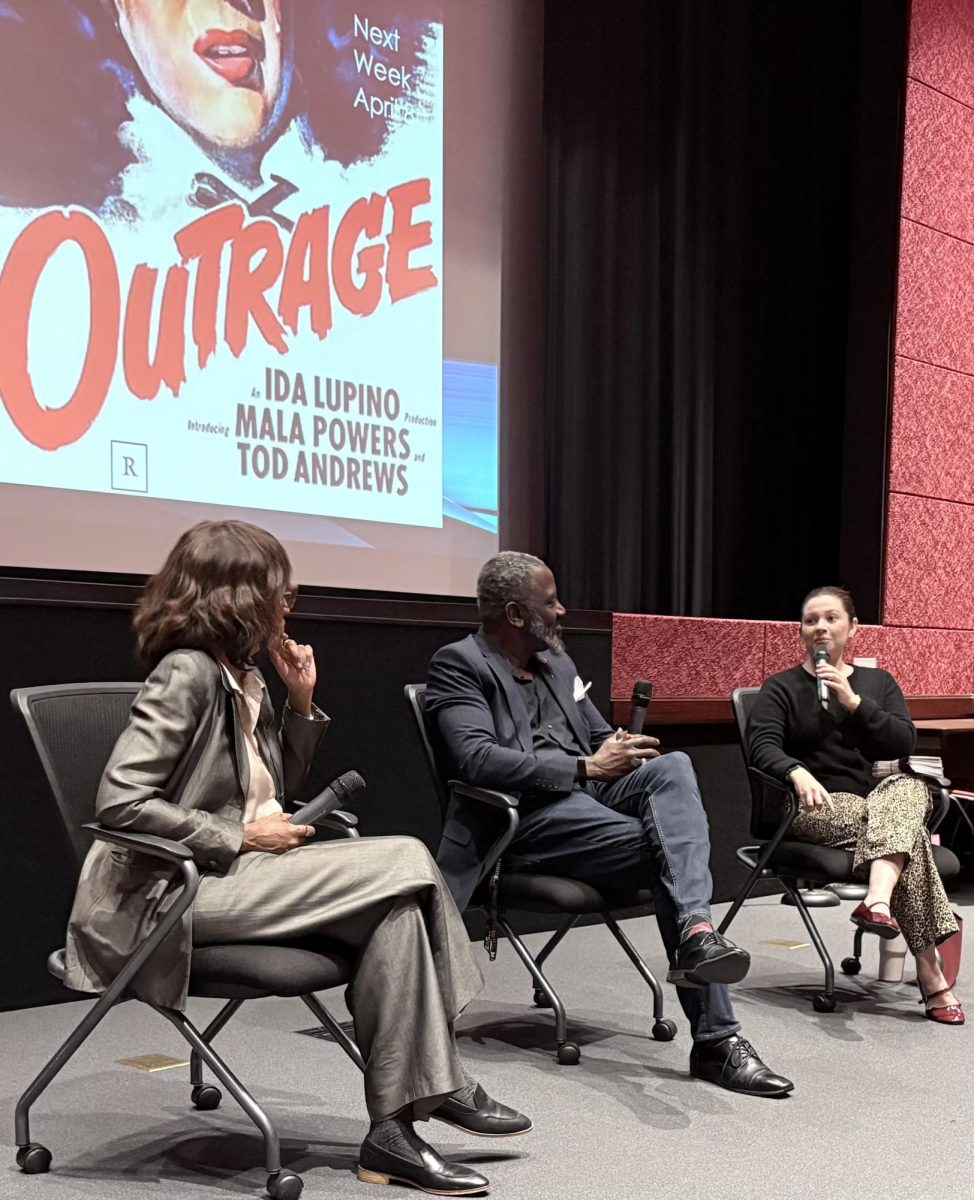
The CSUN Cinematheque series continued Wednesday night with a screening of “Outrage,” part of its ongoing focus on the films of British actress, producer and director Ida Lupino. The screening brought students and faculty together to examine trauma, healing and the portrayal of sexual assault in media.
Hosted at the Elaine and Alan Armer Screening Room, the Cinematheque series highlights influential works in film history, with this semester’s program centered on the films of Lupino, one of the first prominent female directors in postwar Hollywood. Released in 1950, “Outrage” was one of the earliest Hollywood films to address sexual assault, a subject that was largely considered taboo at the time.
Before the film, CTVA professor Dianah Wynter introduced Lupino as “the only woman director in Hollywood of the postwar era,” noting that her work often focused on subjects mainstream audiences and studios were reluctant to confront. “What did Ida Lupino know that doesn’t really happen?” Wynter said during the post-screening discussion. “It doesn’t happen in two hours. It’s not going to happen in two months. It takes a long time to fight one’s way back.”
Following the screening, Wynter was joined by CSUN psychiatrist Abram Milton and Andrea Ortiz, a director at Strength United and family therapist, for a discussion on how “Outrage” portrayed the psychological aftermath of sexual assault without relying on graphic depiction.
Audience members reflected on what they expected the film to show and what it ultimately left out. One student said that they expected to see the assault itself, but appreciated that the film chose not to depict it directly.

“It’s really nice that you didn’t show that,” one audience member said. “It’s so dramatic to actually see.”
Another audience member said they expected a more conventional Hollywood resolution, including a final confrontation between the survivor and her attacker.
“We wanted a Hollywood movie,” Wynter said in response.
She added that audiences often expect clear resolutions in stories like “Outrage,” even though real-life experiences are far more complex.
Ortiz said much of the media she encounters today handles sexual assault in ways that can be more harmful than helpful to survivors.
“Instead of lifting the voices up and empowering survivors, it’s almost retraumatizing many of the survivors,” Ortiz said. “A lot of the media is very graphic.”
Milton echoed that criticism, saying contemporary media often focuses too heavily on explicit violence rather than the survivor’s experience.
“In this film, we focus in about the survivor,” Milton said. “Media today feels like they need to show you every detail to get the point across, and that’s not what’s needed.”
Both panelists emphasized the importance of support systems in recovery, with Ortiz pointing to community as one of the strongest protective factors for survivors and Milton stressing the importance of continuity of care.
“At the first and foremost is that relationship that you build with a survivor,” Ortiz said. “That sense of trust, that sense of safety.”
Milton added that unconditional support can be just as important as clinical treatment. The event also took place during Sexual Assault Awareness Month, adding further relevance to the discussion. As panelists and audience members compared “Outrage” to contemporary media, the conversation focused less on the film’s age and more on how its depiction of trauma still resonates.
The Cinematheque series continues every Wednesday at 7 p.m. until May 6, with screenings like “Outrage” offering audiences an opportunity to engage with films that not only reflect their time, but also challenge viewers to consider how those issues persist today.
If you or someone you love has experienced sexual assault, support is available through CSUN’s Campus Care Advocates and University Counseling Services, which offer confidential counseling and support services. Additional help is also available through Strength United, which provides crisis counseling and advocacy services.