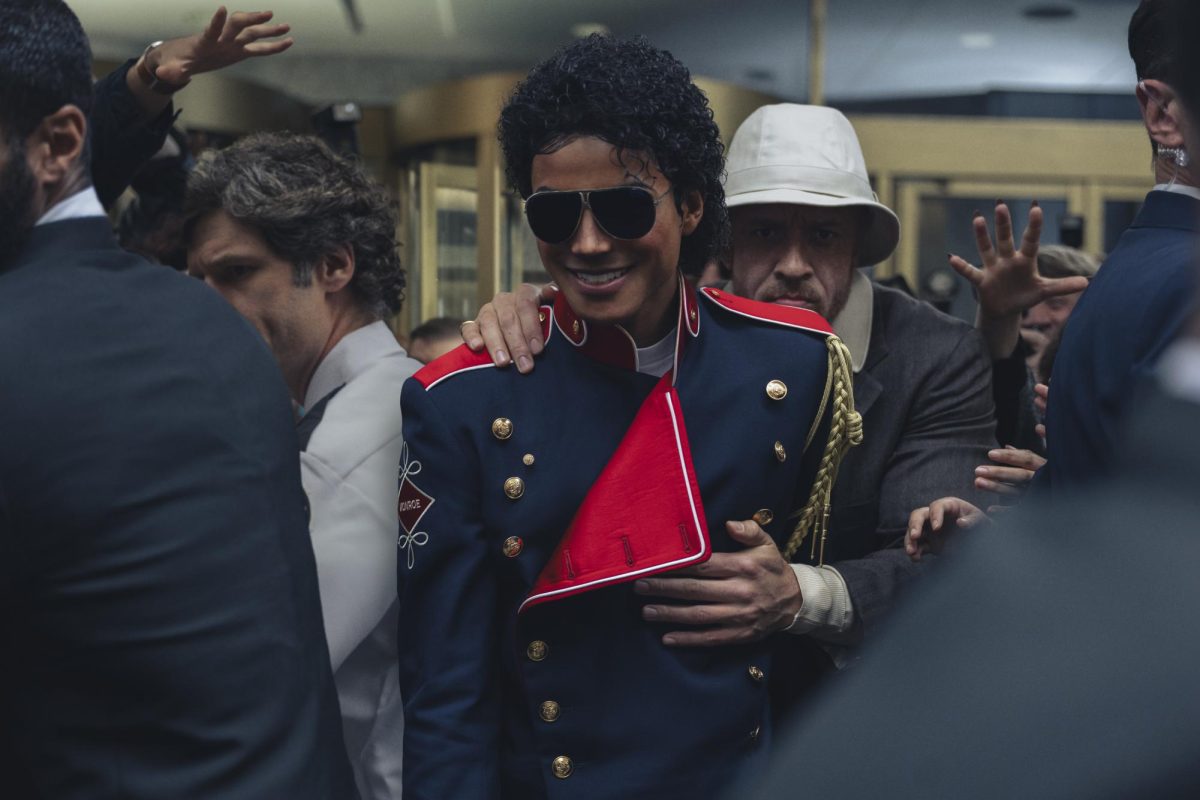
“Michael,” the biographical film directed by Antoine Fuqua, was released on Thursday, April 24. The film follows “King of Pop” Michael Jackson’s upbringing, focusing on how he separated himself from The Jackson 5 and went solo.
Despite its mixed reviews, “Michael” did get some things right. One feature that stands out is its cinematography. With modern technology, it can be difficult to capture the colors and essence of older eras, but it felt like the audience stepped right into the ‘60s and ‘70s. The commitment to keeping production sets alike to real-world events is evident, especially in scenes when Michael was filming a music video or advertisement.
The film’s strongest element is the acting. Colman Domingo, who plays Michael’s father, Joe Jackson, delivered a memorable performance. The emotions he portrayed were ones that could be felt. There were times when I felt afraid of him, as if I were Michael himself.
Juliano Valdi, who played Michael as a child, captured the weight and pressure his father put on him nicely. His singing voice was also strikingly similar to Michael’s as a child, displaying immense talent.
The star of the show was Jafaar Jackson, Michael’s real-life nephew, playing Michael Jackson himself. It was clear throughout the film that Jafaar did not want to disappoint anyone. It seemed like he studied his uncle closely, analyzing every mannerism, tone and movement to make sure he really captured Michael. His dance performances in the film, like in the scenes where he films the “Beat It” and “Thriller” music videos, were nearly identical to Michael’s. Given the pressure on him to deliver a convincing Michael, Jafaar did the role justice.
One of its most interesting aspects is the film’s emphasis on Michael’s childlike interests and personality. Throughout the film, Michael is constantly seen wearing clothing with Mickey Mouse on it, going on a shopping spree at a toy store and spending time in his room filled with toys and games.
Michael’s pull towards having exotic pets as friends is another focal point the film hones in on. This shows Michael did not have a normal childhood and had to grow up faster, unable to make real friends.
Aside from its strengths, the film struggles with pacing. At just over two hours, it’s already a long film. Yet, there are a couple of time jumps that skip over crucial moments in Michael’s childhood. Fitting someone’s entire life within two hours is a challenge. However, the film covers only about half of his lifetime, so it might have been manageable to add a few more details.
The pacing issue becomes more noticeable at the end, when we cut to the final sequence depicting Michael’s 1988 “Bad” tour, four years after his last show with The Jackson 5. This four-year time jump made the story feel incomplete and left the audience unsatisfied. It was an abrupt ending that could have used some more storytelling, rather than the final scene simply being a performance.
The film ends with a black screen that reads, “His story continues,” alluding to a sequel. According to The Hollywood Reporter, Lionsgate film chair Adam Fogelson stated that they “absolutely have more story to tell,” and that support from fans may determine whether they’re given a chance to tell that story. Although it is not confirmed, a sequel is on the table.
“Michael,” supported by strong cinematography, succeeds in capturing the characters’ personalities through immersive acting. However, the inconsistent and quick pacing breaks immersion at times. Audiences may leave the theater with unanswered questions, but overall, the film is a worthwhile watch.