
Stephen Pierce, a professor at the University of Southern California (USC), spoke at CSUN on Thursday as part of the Distinguished Speaker Series, introducing students to the Royal Conservatory of Music Certificate Program and its role in structured music education.
Held at the Shigemi Matsumoto Recital Hall, the event focused on the Royal Conservatory of Music (RCM), a Toronto-based institution whose certificate program provides comprehensive, structured training in performance, technique, musicianship and theory across multiple instruments and disciplines.
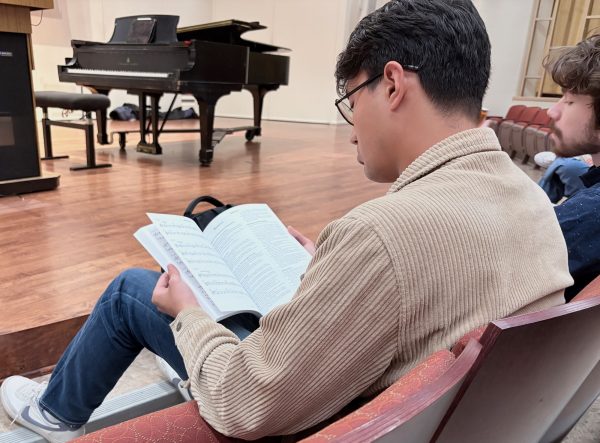
The program allows students to progress from beginner to advanced levels, with benchmarks that build technical and theoretical skills. It is used by hundreds of thousands of students across North America each year.
Pierce, who teaches piano pedagogy and oversees non-major instruction at USC’s Thornton School of Music, said the program offers students a comprehensive framework for musical development.
“If you don’t know what the RCM is, don’t worry. I’m about to introduce it,” Pierce said. “I truly believe this is the pathway to music excellence for every student.”
Pierce said one of the program’s main strengths is its progression, which integrates technical skills, repertoire, ear training and sight reading rather than treating each area separately.
“One of the reasons that I got involved in the RCM certificate program is because I was using this with my students,” Pierce said. “I was having success with my students in the program.”
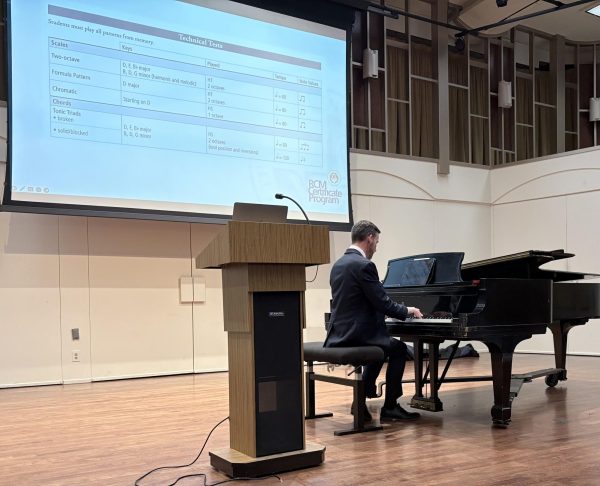
Throughout the session, Pierce demonstrated elements of the curriculum at the piano and shared recordings of students performing as examples of how the program develops musicianship over time.
The live demonstration provided students with a practical example of how the curriculum is applied in real time.
Pierce also described the importance of third-party assessment through RCM examinations, which are available both in person and online. According to him, the exams are designed not only to evaluate students’ playing but also to provide constructive feedback and encourage long-term growth.
“It helps to keep me accountable as a teacher,” Pierce said. “It’s important for our students to have other trusted ears hearing them, offering objective feedback.”
Pierce said the program’s value extends beyond students pursuing professional performance careers, noting that many participants use it as a foundation for lifelong engagement with music.
“This is a program that really prepares students for success, no matter what their chosen field is,” Pierce said.
During the Q&A portion of the event, students asked Pierce about topics ranging from artificial intelligence and assessment to accessibility for students from different socioeconomic backgrounds.
Pierce explained that the program can be adapted to different student needs and that flexibility is an important part of his teaching.
“I try to not teach anything too dogmatically,” Pierce said. “You have to make it work for every student.” As the event concluded, Pierce encouraged students to follow up with him directly if they had additional questions about the program, underscoring the event’s broader focus on pedagogy and student growth within music education.