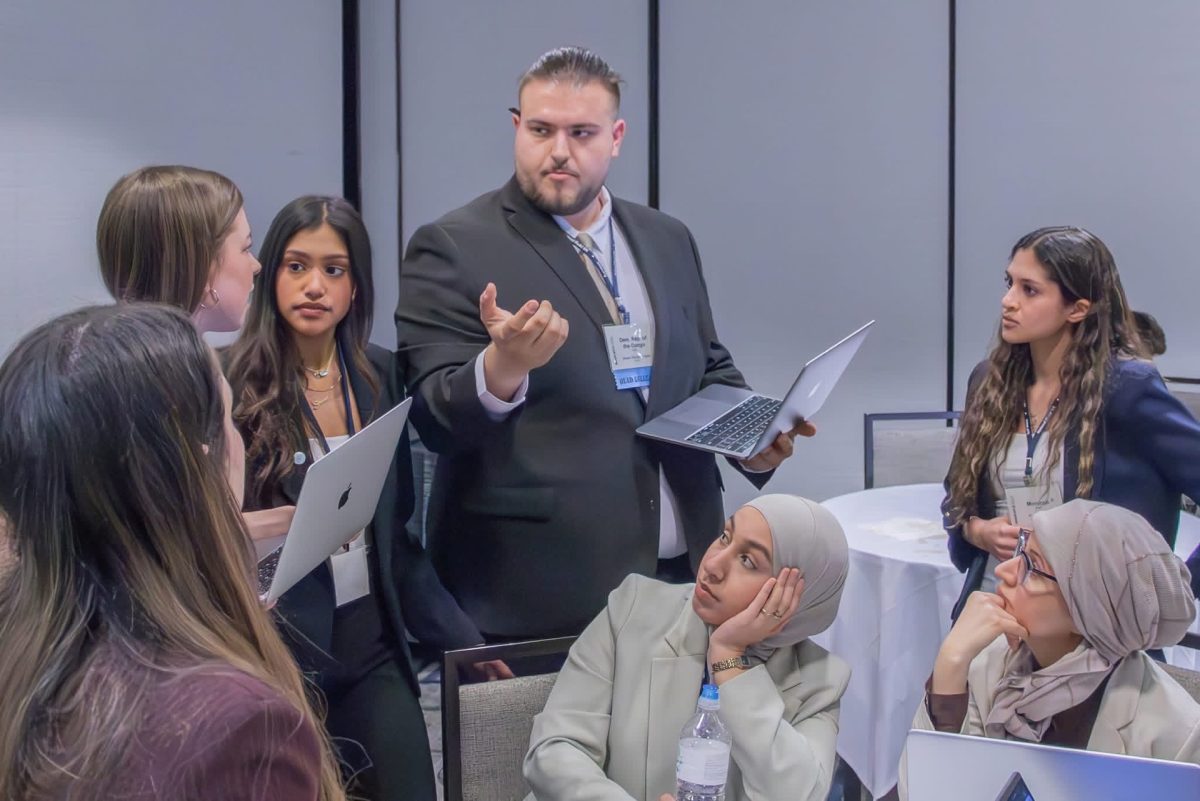
The Model UN at CSUN returned from their trip to New York on Friday, April 10, where they participated in the bi-annual National Model United Nations Conference. The class represented the Democratic Republic of Congo and wrote position papers on various topics, including security and human rights issues.
The conferences, which have existed almost as long as the United Nations, are meant to mimic the experience of an actual UN conference, with general assembly committees and specialized committees. Students in the class are given topics ahead of time to research and draft arguments and position papers from the perspective of the country they are representing.
The eight-member team brought home an Outstanding Delegation award for their performance in the conference, as well as three awards for position papers.
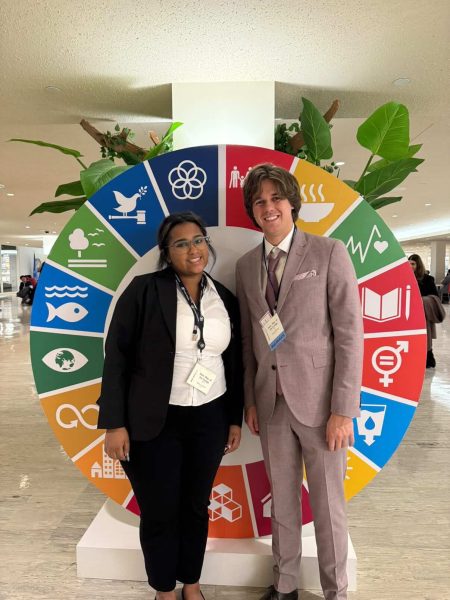
The Model UN team from CSUN has been active for over 20 years, bringing home awards from conferences with other colleges and universities from the nation and around the world. The group is run primarily by students, called head delegators, with a professor overseeing the process.
Arsen Penerdzhyan, who has participated in four conferences at CSUN, attended his final conference before graduating as a head delegate for the class, guiding students in research and preparation. Having originally joined the class for internship credit, he said that the experience that he gained from this program has created lasting change and community.
“I’d be lying to you if I said it wasn’t very bittersweet, because this genuinely is my life,” he said. “I have never felt more dedicated and more passionate about a single thing ever, and I love this with all my heart. I wish I could do this forever, but I have to graduate eventually.”
Typically, CSUN represents two countries, such as last semester when they represented Somalia and Botswana in Washington, D.C. For their latest conference, however, they only represented the Democratic Republic of Congo. Penerdzhyan said that even though this change makes it more difficult to win awards, it does allow the group more time and resources to dedicate to research. It also means that there is no partner country to lean on during the conference.
“Usually, we’ll have two countries in one committee, and they can help each other out,” he said. “This time they were all alone [in pairs], and that’s why I’m even more proud of how well they did because they were alone.”
Head Delegate Mason Malina said that finances impact the number of countries that a college can represent. While CSUN usually has two countries, some community colleges have only one, and other universities, such as Florida Atlantic University, are able to represent up to eight countries.
Previous Head Delegate Ann Anserlian attended last semester’s conference in Washington, D.C., and was able to work on her public speaking skills as well as build up her confidence in leadership roles.
“Entering the class, I was not so sure on my skills when it comes to, like, global politics and issues in the world,” she said. “Taking the class helps you open up, and you learn how to work with other people, especially from all around the world.”
Although she does not plan to be involved in international relations, Anserlian hopes that the skills that she has learned through her leadership role will help her in her future career as a lawyer.
“Honestly, the class has just helped me become more confident in, like, my public speaking abilities and just the way I hold myself,” she said. “It helped me prepare for the long run and like the career I want to go to, and just learning how to talk to different types of people.”
Anserlian also described the connections she made at the conference. She and Malina say that they keep in close contact with the delegates they have met at conferences.
Anserlian and Malina were assigned to a specialized committee, called the security council, where they covered issues such as the tensions in Haiti and the use of AI in automated weapons.
As someone who plans to work in international relations, Malina thinks that there is value to having first-hand experience participating in conferences rather than only learning about them through a textbook.
“It really is another thing to kind of live some of that experience,” Malina said. “Even though it is just simulation, you really get a taste of the kind of, you know, what challenges are facing not just the world, but what challenges are facing international cooperation.”
Last semester’s conference covered topics such as the security council and sustainable tourism. They took home six awards total, with one university-wide award for Distinguished Delegation.
Along with the Distinguished Delegation award, the Model UN also brought home four awards for Best Position Paper, as well as an Outstanding Delegates award for Malina and Mason’s performance on the Security Council.
Political Science Professor Jennifer De Maio has run the program since 2013 and said that she enjoys seeing her students grow into their roles and hone skills that they can take with them into their careers. As someone with little experience with model UNs, she said that her students helped make the transition easier.
“One of the most rewarding things for me is to watch somebody come into the classroom who’s terrified of getting up and speaking in front of a group and watching them just evolve over the semester,” De Maio said. ”When I can witness that type of personal growth, it’s so gratifying.”
Additionally, De Maio said that the class has students from all walks of life, and she is proud to be able to represent the diverse community that CSUN has.
Since De Maio stepped in to teach the Model UN class, CSUN has taken home awards for 13 consecutive years. She said that these conferences have helped to put CSUN on the map and that other schools now know that “CSUN is the team to beat.”
“We have a really high, strong reputation now, which makes me really proud,” De Maio said.
Even though the class can be labor-intensive, with a four-hour class every Friday, De Maio and each head delegate agree that the experience and community that they receive from the class is something that they keep coming back for.
“[You] build a wonderful connection and going through the trenches with each other,” Penerdzhyan said. “You can’t help but end up becoming close. … Once you’re in it, it’s like you can never see yourself leaving.”
Editor’s note: A correction was issued on April 16, 2026 to correct the amount of awards won this year.